11 Smart RV Storage Ideas You Can Use to Organize Your RV
RV storage can become frustrating quickly when every cabinet, drawer, and corner has to serve a purpose. I have found that keeping an RV organized is less about having a huge amount of storage and more about using the space already available in a smarter way. A few simple changes can make the kitchen easier to use, keep the bathroom from becoming cluttered, and give everyday items a proper place.
The best RV storage ideas also need to work while traveling. An organizer might look perfect when the RV is parked, but it is not very useful if everything falls over as soon as you start driving. I prefer storage solutions that keep things secure, easy to reach, and simple to maintain.
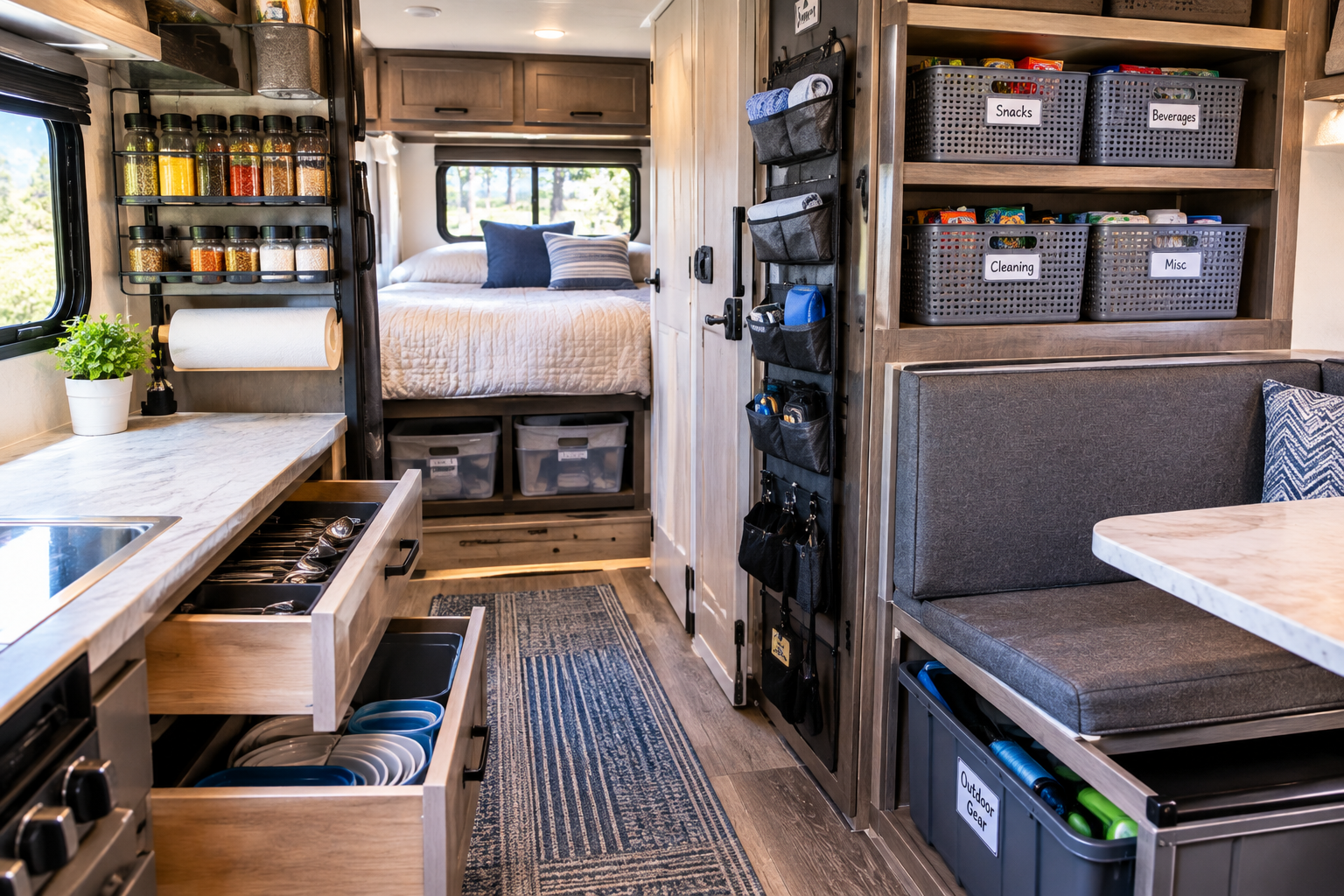
In this guide, I am sharing 11 practical RV storage ideas that can help you make better use of your available space without making the RV feel crowded. These are the types of changes I would focus on before buying a lot of new storage products.
1. Use the Space Under the Bed
The space underneath the RV bed is one of the areas I always want to use properly because it can hold a surprising amount without taking up any living space.
It works especially well for items that I need during a trip but do not use every day. I like keeping extra bedding, shoes, outdoor equipment, spare supplies, and seasonal items in this area.
Storage bags or low profile containers make a big difference because they prevent everything from becoming one large pile. I also recommend grouping similar items together instead of putting things wherever there happens to be room.
For example, one container can hold outdoor supplies while another holds extra bedding. That way, I can pull out the container I need without emptying the entire storage compartment.
Another useful trick is to keep heavier items lower and closer to the center of the RV when possible. This makes the storage area easier to manage and avoids creating unnecessary weight in awkward locations.
Before buying containers, measure the available space carefully. RV beds and storage compartments can have unusual dimensions, so a container that looks perfect online may not actually fit.
2. Add Storage Bins Inside Cabinets
RV cabinets can hold plenty of supplies, but without smaller containers, they can quickly turn into a collection of loose items.
I like using storage bins to divide larger cabinets into smaller sections. Instead of reaching into the back of a cabinet and moving several things around, I can pull out one bin and find what I need.
This works particularly well in kitchen cabinets.
One bin can hold snacks, another can hold coffee and tea supplies, while another can hold cooking accessories. In the bathroom, smaller bins can separate skincare, hair products, cleaning supplies, and personal care items.
I also prefer containers that are easy to lift. Deep bins may look efficient, but they can become frustrating if I have to remove several containers just to reach something at the back.
Clear containers are useful when I want to see what is inside without opening them. Solid containers can also work well when I want the RV to have a cleaner, less cluttered appearance.
The important thing is not to fill every container simply because you have one. Leave enough room to remove them easily.
3. Use the Inside of Cabinet Doors
The inside of a cabinet door is easy to overlook, but it can provide useful extra storage without taking up shelf space.
This is one of my favorite areas for lightweight items that I use regularly.
Small hooks, adhesive organizers, narrow pockets, and slim racks can work well here. In the kitchen, this space can hold measuring spoons, small cooking tools, pot holders, or lightweight cleaning supplies.
In the bathroom, it can be useful for brushes, small toiletries, or other lightweight personal items.
I would avoid putting anything heavy on a cabinet door because the extra weight can place unnecessary stress on the hinges, especially when the RV is moving.
I also make sure the door can still close properly after adding an organizer. The last thing I want is to create a storage solution that prevents the cabinet from closing securely.
Before attaching anything permanently, I measure the door and check how much clearance is available between the door and the shelf contents.
4. Make Use of Vertical Wall Space
When floor and cabinet space are limited, I look upward.
Vertical wall space can become useful storage for small items that would otherwise end up on counters, tables, or other surfaces.
Hooks are one of the simplest options. They can hold jackets, hats, towels, bags, keys, or lightweight camping accessories.
A narrow wall mounted organizer can also work well for items that need to stay accessible throughout the day.
The trick is choosing the right location. I do not want to add storage to a wall simply because there is empty space. I look at where I naturally reach for something and place the storage close to that area.
For example, a hook near the entrance makes more sense for keys or jackets than one across the RV. A small organizer near the kitchen can keep frequently used tools within easy reach.
I also avoid blocking windows, vents, electrical controls, or important access points.
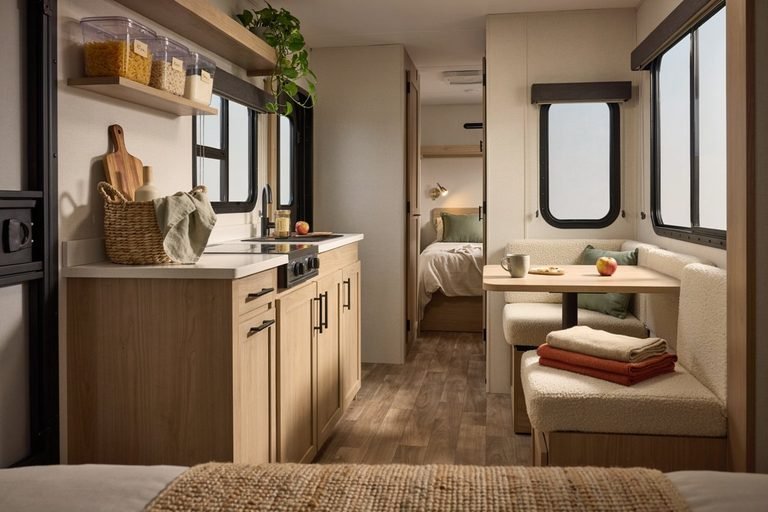
5. Organize the RV Pantry by Category
A small RV pantry can hold much more when everything has a designated place.
Instead of stacking food randomly, I like organizing items by category. Snacks can stay together, breakfast supplies can have their own area, and cooking ingredients can be grouped separately.
Stackable containers can make better use of vertical space, especially when pantry shelves are tall. Narrow bins are also useful because they allow me to pull out an entire category instead of reaching around individual packages.
I also pay attention to what I use most often. Everyday items should be placed where they are easy to reach, while backup supplies can go toward the back or on a higher shelf.
One mistake I try to avoid is buying too much food simply because there is available storage. An organized pantry can still become overcrowded if I keep adding supplies without checking what I already have.
Before each longer trip, I like to take a quick inventory and use older supplies before buying duplicates. This keeps the pantry easier to manage and prevents valuable storage space from being wasted.
6. Use Overhead Cabinets for Lightweight Items
The overhead cabinets can provide a lot of useful storage, especially in a smaller RV where floor space is limited. I like using these cabinets for lightweight items that I need during the trip but do not necessarily reach for every few minutes.
Extra towels, bedding, paper products, lightweight kitchen supplies, and clothing can work well in this type of storage.
I avoid putting heavy objects into overhead cabinets whenever possible. Weight stored high in the RV can affect how the space feels while traveling, and loose items can also shift around when the RV is moving.
Small baskets can make overhead cabinets easier to manage because they keep similar items together. Instead of having several loose items sliding around on the shelf, I can lift one basket out and get what I need.
I also leave a little room between the contents and the cabinet door. This helps prevent items from pressing against the door when I am driving.
Before every trip, I give these cabinets a quick check to make sure everything is secure.
7. Create a Dedicated Shoe Storage Area
Shoes can make a small RV look messy very quickly because they tend to collect near the entrance.
Creating one dedicated shoe storage area solves much of the problem.
I prefer keeping shoes close to the entrance so I can take them off as soon as I come inside. A narrow shoe organizer, small storage bench, basket, or low container can work depending on the layout of the RV.
I would not dedicate valuable cabinet space to shoes unless the layout makes sense for it. The entrance area is usually much more practical because shoes are already coming through that space.
I also try to keep the number of shoes reasonable. It is easy to bring several pairs because each one seems useful, but shoes take up valuable storage space.
For most trips, I think about the activities I actually have planned and choose shoes that can work for multiple situations.
A comfortable walking pair is usually the priority for me. Then I add other footwear only when the destination or activities make it necessary.
8. Use the Space Under the Dinette
The area underneath an RV dinette can be one of the most useful hidden storage spaces.
It is especially helpful for larger items that do not fit comfortably inside regular cabinets.
I like using this type of space for outdoor equipment, extra supplies, tools, games, seasonal items, and things that I do not need constantly throughout the day.
Storage bags can help keep the compartment organized, but I do not like filling it with too many individual containers. If I have to remove five things to reach one item, the storage system becomes frustrating.
I usually group items according to how often I use them.
Things I need regularly stay toward the front or in an easy to reach container. Items I only need occasionally can go farther back.
This is also a good place to keep bulky but relatively lightweight items that would otherwise take up cabinet space.
Before loading this area, I check how much weight the storage compartment and surrounding structure can safely handle. RV storage spaces are not all designed for the same amount of weight.
9. Add Hooks Where You Naturally Need Them
Hooks are one of the simplest ways to create extra storage without taking up much room.
I like placing them in areas where items naturally get dropped or left behind.
A hook near the entrance can hold keys, hats, jackets, or a small bag. Bathroom hooks can hold towels and lightweight personal items. Kitchen hooks can keep small utensils or towels within easy reach.
The important part is not adding hooks everywhere. Too many hooks can make the RV feel cluttered instead of organized.
I think about the problem I am trying to solve first.
If towels constantly end up on a counter, a towel hook makes sense. If jackets keep getting thrown onto the dinette, an entrance hook could solve the problem.
I also pay attention to the type of surface before installing anything. Some RV walls are better suited to certain mounting methods than others, so I want to make sure the hook is secure and appropriate for the wall.
For items that will be used while traveling, I make sure the storage method keeps them secure instead of allowing them to swing or fall.
10. Give Every Item a Permanent Home
This is probably the storage habit that makes the biggest difference in my RV.
Every item needs a specific place.
When something does not have a home, it usually ends up on the kitchen counter, dinette, bed, or floor. Those surfaces can become cluttered surprisingly quickly in a small RV.
I try to decide where an item belongs based on how often I use it and where I use it.
Kitchen tools stay near the kitchen. Towels stay near the bathroom. Outdoor supplies stay close to the area where I access them. Travel documents and important personal items stay together rather than being scattered around the RV.
This system also makes packing up much easier.
When I am ready to leave a campsite, I do not have to wonder where everything belongs. I simply return each item to its designated storage area.
I find it especially helpful to keep the same arrangement from trip to trip. Changing the location of everything every time I reorganize the RV might make sense during the initial cleanup, but consistency makes daily life much easier.
11. Choose Storage That Works While You Travel
An RV storage system needs to work when the RV is moving, not just when it is parked.
This is something I always keep in mind before adding a new organizer or container.
A basket sitting neatly on a shelf may look great at the campsite, but if it slides around during travel, it is not doing its job properly.
I prefer containers that fit securely inside cabinets and storage compartments. For loose items, I look for simple ways to keep them from moving around.
Cabinet doors should close securely, drawers should not become overloaded, and heavier items should stay in appropriate lower storage areas.
I also avoid storing fragile items in places where they can easily fall or shift.
Before leaving a campsite, I take a few minutes to walk through the RV and check the kitchen, bathroom, bedroom, and living area. I close cabinet doors, secure loose items, and make sure everything has returned to its proper place.
That small routine saves me from discovering a messy RV after the next drive.
Common RV Storage Mistakes to Avoid
One of the biggest mistakes is buying storage products before figuring out what actually needs to be organized. It is easy to see attractive RV organizers and assume they will solve every problem, but too many containers can actually make a small space harder to use.
Another mistake is storing heavy items in high cabinets. I prefer keeping heavier supplies lower and using upper storage for lighter belongings.
I also avoid filling every available space. Empty space can be useful because it gives me somewhere to put things temporarily and makes it easier to access what I already have.
Another common problem is keeping duplicate items. Before buying another kitchen tool, cleaning product, or camping accessory, I check what is already in the RV.
Most importantly, I do not organize the RV based only on how it looks when parked. I organize it around how I actually use it.
A beautiful storage system is not very helpful if I have to move half the RV every time I need one item.
My Simple RV Storage System
After trying different ways to organize an RV, I have found that the simplest systems are usually the easiest to maintain. I do not want an RV that looks perfectly organized for one afternoon and becomes cluttered again after a few days.
My storage system starts with dividing everything into categories.
Kitchen items stay together. Bathroom supplies stay together. Clothing has its own space. Outdoor equipment stays in storage areas that are easy to access from outside when possible. Important documents and personal items stay in one dedicated location.
I also think about how frequently I use each item.
Things I reach for every day should never be buried at the back of a cabinet. Items I only need occasionally can use less convenient storage space.
This small change makes a big difference because I am organizing around real life rather than simply trying to make every cabinet look full and tidy.
Keep Frequently Used Items Within Easy Reach
One of the easiest ways to make an RV feel more functional is to keep everyday items within easy reach.
I do not want to open several cabinets just to find the coffee supplies I use every morning or move multiple containers to reach something I need for cooking.
I usually place frequently used items in the easiest locations.
This might mean keeping everyday kitchen tools in the front of a drawer, placing towels close to the bathroom, or keeping commonly used outdoor items in an accessible storage compartment.
The goal is to reduce unnecessary movement.
When an RV is small, even a few extra steps can make everyday tasks feel more complicated. Keeping frequently used items close to where they are needed makes the entire space easier to live in.
Use Labels When They Actually Help
Labels can be useful, especially when several storage containers look similar.
I find them most helpful for areas where I keep backup supplies or items that I do not use every day.
For example, a storage bin might contain electrical accessories, another might hold outdoor equipment, and another might contain seasonal items.
A quick label means I do not have to open every container to find what I need.
I would not label every drawer and cabinet in the RV, though. Too many labels can make a simple storage system feel unnecessarily complicated.
I use them where they save time.
Leave Room for the Things You Collect During a Trip
One mistake I try to avoid is filling every available storage space before leaving home.
An RV trip rarely ends with exactly the same amount of stuff that started the journey.
You might buy groceries, collect souvenirs, pick up supplies, or simply move items between different areas of the RV.
Leaving a little spare space gives you room to handle those changes.
I especially like keeping one small area available for items that need to be put away later. This prevents temporary clutter from spreading across the dinette and kitchen counters.
Having extra storage capacity also makes longer trips easier because I do not have to constantly rearrange everything just to make room for something new.
Create a Quick Reset Routine
Keeping an RV organized is much easier when I reset it regularly instead of waiting until everything becomes messy.
At the end of the day, I take a few minutes to return things to their proper places.
Kitchen items go back into their cabinets. Shoes return to the entrance area. Towels are hung up. Outdoor equipment is returned to its storage space.
This does not need to become a long cleaning session.
A short reset can make the next morning much easier because I am starting with a clean and organized space.
I also find this especially useful before moving to another campsite. Putting everything away gradually means there is much less to do when it is time to travel.
Do a Storage Check After Every Trip
Every trip gives me useful information about what works and what does not.
After returning from a trip, I look at the storage areas and ask myself a few simple questions.
Was anything difficult to reach?
Did something move around while traveling?
Did I pack something that I never used?
Did I need an item that was buried too far back?
Did one storage area become overcrowded?
These questions help me improve the system gradually.
Instead of completely reorganizing the RV every few months, I can make small changes based on how I actually use the space.
I might move a frequently used item closer to the entrance or switch the contents of two storage bins. Small adjustments can make a surprisingly big difference.
How to Keep Your RV Organized Long Term
The best RV organization system is one that you can maintain without constantly thinking about it.
I try to follow a few simple habits.
Keep similar items together.
Return items to their designated storage area.
Avoid buying duplicates.
Use vertical space when practical.
Keep heavy items in appropriate lower storage areas.
Do not overcrowd cabinets.
Leave room for new supplies.
Secure loose items before driving.
Review storage after each trip.
These habits are more useful to me than constantly buying new organizers.
Storage products can help, but they cannot replace a simple system.
My Favorite Way to Declutter an RV
When an RV starts feeling crowded, I like to remove everything from one storage area rather than trying to reorganize the entire RV at once.
I put the items into three groups.
The first group contains things I use regularly.
The second contains things I use occasionally.
The third contains things I no longer need or items that have a better storage location somewhere else.
This method makes it much easier to see what is actually taking up space.
I also look for duplicate items. RVs can accumulate extra kitchen utensils, cleaning supplies, tools, cables, and camping accessories surprisingly quickly.
Removing even a few unnecessary items can make the available storage feel much larger.
Expert Tips for Better RV Storage
One of my biggest recommendations is to measure before buying storage products. RV cabinets, drawers, and compartments often have unusual shapes, so knowing the exact dimensions saves money and frustration.
Think about weight as well as space. A storage container may fit perfectly but become too heavy once filled.
Use clear containers when visibility matters and solid containers when you want a cleaner appearance.
Keep everyday items easy to reach and less frequently used items farther away.
Use vertical space without blocking windows, vents, controls, or access points.
Most importantly, organize according to how you actually live in the RV.
Your storage system does not need to look like someone else’s RV. It needs to make your own daily routine easier.
Final Thoughts
Smart RV storage is not about squeezing as many things as possible into every cabinet and compartment. It is about making the space you already have work better.
The biggest improvements often come from simple changes such as using the space under the bed, adding bins inside cabinets, taking advantage of cabinet doors, using vertical wall space, organizing the pantry, and giving every item a permanent home.
I also find that keeping a little empty space is just as valuable as adding storage. It gives the RV room to breathe and makes it easier to handle groceries, outdoor gear, and other things that come along during a trip.
Once everything has a logical place, packing up becomes easier, finding things takes less time, and the RV feels much more comfortable.
The goal is not to create a perfect RV. The goal is to create an organized space that works naturally while you are traveling, camping, cooking, relaxing, and enjoying the road.