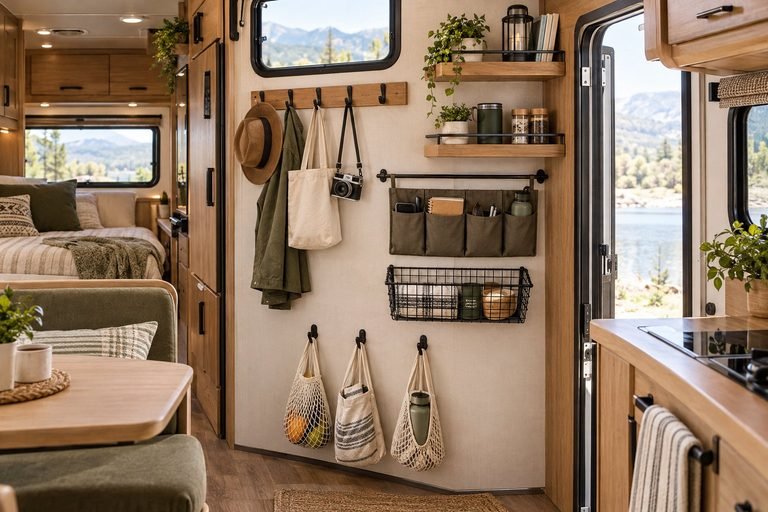
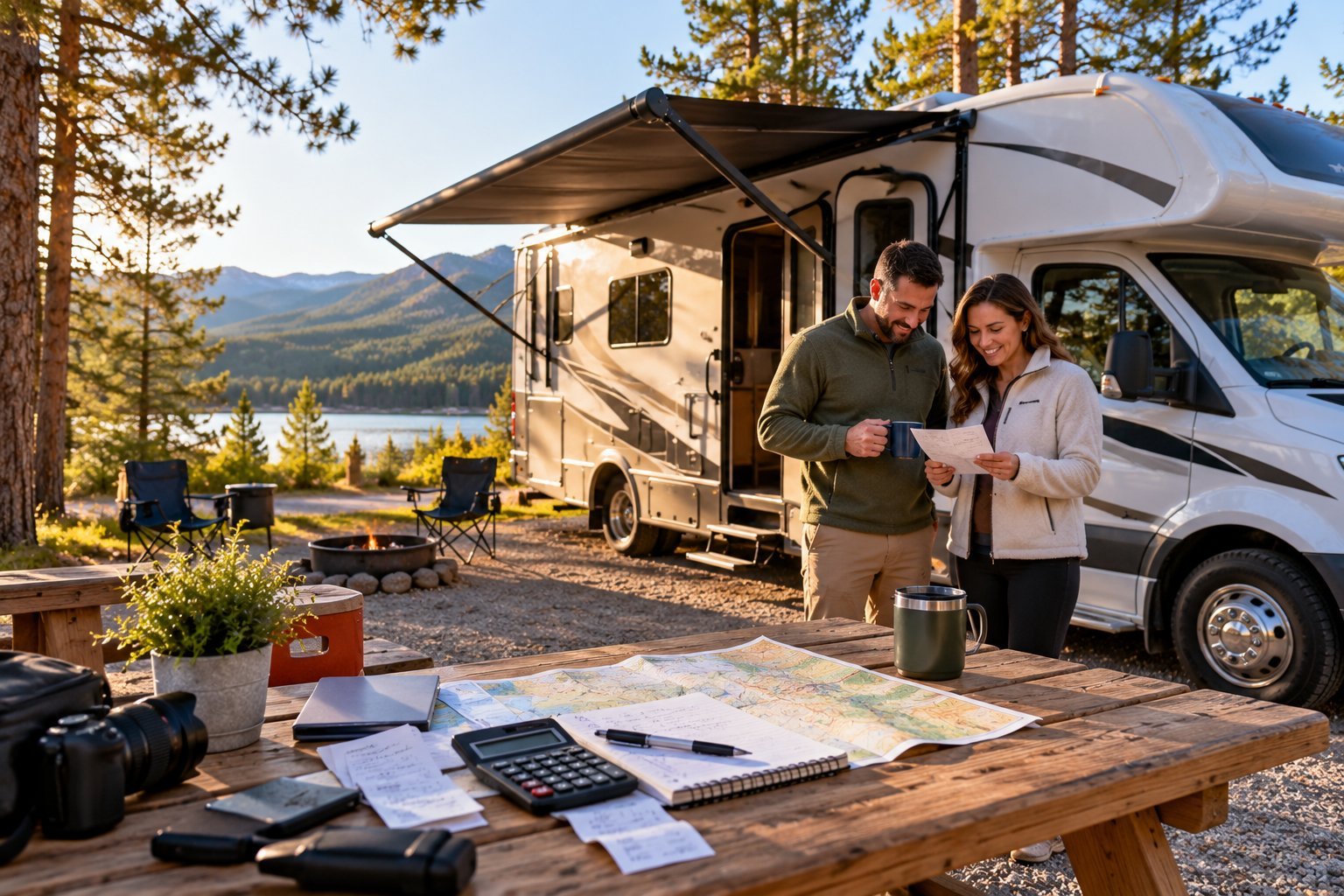
What It Actually Costs to Live in an RV Full Time: Hidden Fees We Didn’t Expect
Living in an RV full time sounds like a great way to simplify life, explore new places, and spend less money on housing.
You imagine waking up beside a lake, making breakfast in your little kitchen, and moving whenever you feel ready for a change of scenery.
But before making that lifestyle your everyday reality, there is one question worth answering honestly: how much does it actually cost to live in an RV full time?
The purchase price is only the beginning. You still need somewhere to park, fuel to travel, insurance, groceries, internet, and money for repairs.

Then there are the smaller expenses that can quietly add up, including campground electricity, laundry, dump stations, replacement hoses, and unexpected overnight stays.
I would never plan an RV budget around the cheapest possible scenario alone. The better approach is to understand what everyday life costs, identify the hidden fees, and leave room for the unexpected.
In this guide, I will break down the major expenses, explain what catches new RV owners off guard, and show you how to prepare a more realistic monthly budget.
What Does It Actually Cost to Live in an RV Full Time?

The honest answer is that there is no single monthly price for full-time RV living. Your costs depend on the RV you own, how often you move, where you stay, whether you have a loan, and how comfortably you want to live.
For planning purposes, a couple living full time in an RV might spend approximately $1,500 to $4,500 per month before RV loan payments and certain personal expenses. A more expensive travel style, high repair bills, health insurance, or resort campground stays can push the total much higher.
A paid-off RV, slower travel, and frequent low-cost camping can reduce it substantially. These are illustrative US-dollar budgeting ranges, not guaranteed averages. <Cite refs={[“turn283606search0″,”turn283606search1″,”turn283606search7”]}/>
Here is a useful starting point.
| Expense | Illustrative monthly budget |
|---|---|
| Campground and parking fees | $300–$1,200 |
| Fuel | $150–$600 |
| RV insurance | $100–$300 |
| Maintenance and repair savings | $150–$350 |
| Groceries and household supplies | $400–$800 |
| Phone and internet | $75–$200 |
| Propane, laundry, and utilities | $75–$250 |
| Miscellaneous and unexpected expenses | $100–$300 |
These figures are planning estimates. Your actual costs may fall outside these ranges, particularly if you travel extensively, finance an expensive motorhome, pay for health insurance separately, or spend winter in a premium RV resort.
The figures also do not automatically include an RV loan, healthcare, taxes, or every annual expense. Those need to be added according to your situation.
The biggest lesson is that you should calculate the cost of your intended lifestyle, not someone else’s cheapest month on the road.
1. Campground Fees Can Cost More Than You Expect

Where you park your RV is one of the biggest decisions affecting your monthly budget.
It is easy to see an advertised nightly rate and assume you can multiply it by the number of nights you need. However, the actual cost can change depending on the season, location, length of stay, hookups, and additional campground charges.
For example, a campsite advertised at $45 per night would cost $1,350 for 30 nights before taxes or extra charges. If you move between several campgrounds throughout the month, the total can climb quickly.
Monthly rates may be more economical, but they are not always available, and some parks have restrictions on how long guests can stay.
Hidden campground charges to check
Before booking a site, ask whether the advertised price includes everything you need.
Potential additional charges include:
- Electricity billed separately from the campsite.
- Extra guest or additional vehicle fees.
- Pet fees or restrictions.
- Resort or amenity fees.
- Taxes and booking charges.
- Laundry and shower fees at some facilities.
- Deposits or cancellation penalties.
- Premium charges for holidays, weekends, or peak seasons.
Not every campground charges these fees. The important thing is to check the complete price instead of relying on the headline rate.
I would also check the site itself before booking. A cheaper campsite can become inconvenient if it lacks the hookups you need, cannot accommodate your RV’s length, or leaves you paying for another location sooner than expected.
How to keep campground costs under control
Staying longer in one location can reduce the cost of frequent nightly bookings. You can also mix paid RV parks with suitable public campgrounds and legal dispersed camping where available.
Before relying on free camping, check stay limits, access restrictions, fire rules, road conditions, and whether your RV can operate without hookups. Free parking does not always mean a practical or cost-free stay.
2. Electricity May Not Be Included in Your Site Fee
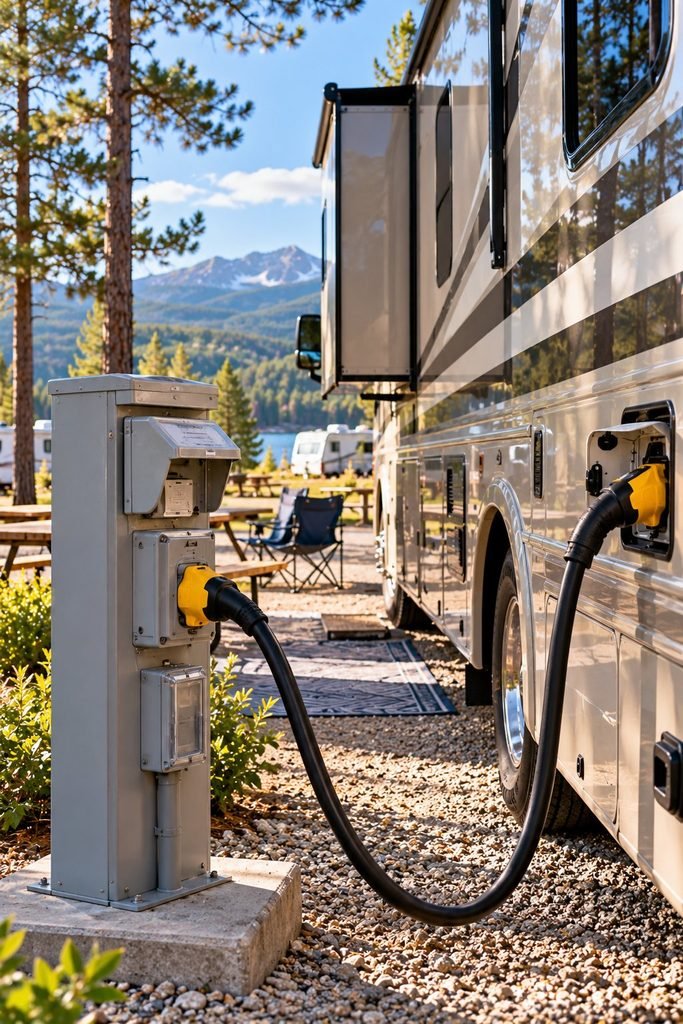
One of the costs worth checking before committing to a long-term campground is electricity.
Some parks include electricity in the nightly rate, while others meter it separately, especially for monthly guests. If you are staying for several weeks or months, that difference can affect your budget.
Your electricity use depends on the RV’s equipment, the local climate, and how you live. Air conditioning during hot weather and electric heating during cold periods can increase consumption considerably.
What makes RV electricity expensive?
Air conditioners, electric space heaters, water heaters, cooking appliances, and other high-demand equipment can use substantial power. If your RV has older appliances or poor insulation, keeping the interior comfortable may require more energy.
Before booking a monthly site, ask:
- Is electricity included in the quoted rate?
- If it is metered, what is the billing method?
- Is there a separate charge or deposit?
- Are there limits on electrical usage?
- Does the site provide the electrical connection your RV requires?
Do not assume that an advertised monthly rate covers every utility.
Ways to reduce electricity costs
Use your RV’s insulation, window coverings, and ventilation effectively. Choose energy-efficient lighting, turn off equipment when it is not needed, and use heating or cooling thoughtfully.
If you are considering solar panels, remember that the system itself costs money and may not cover every appliance or weather condition. It can reduce reliance on campground power in suitable circumstances, but you should calculate the initial investment before expecting savings.
3. Fuel Costs Add Up Every Time You Move

Travel is one of the most enjoyable parts of RV living, but it is also one of the easiest expenses to underestimate.
An RV is not necessarily fuel-efficient, particularly if you drive a large motorhome or tow a heavy trailer. The more often you change locations, the more fuel you are likely to use.
A slow traveler who stays in one campground for several weeks may spend far less than someone who drives hundreds of miles every few days.
Why fuel budgets go wrong
Many people estimate fuel costs based on the distance between major destinations without accounting for everyday driving.
You may need to drive to a grocery store, laundromat, repair shop, dump station, or medical appointment. You may also take detours to avoid difficult roads or visit attractions away from your campground.
If you tow a vehicle behind a motorhome, or use a separate tow vehicle for a travel trailer, remember to include the fuel costs for those trips as well.
How to estimate your monthly fuel bill
Use a simple calculation:
Monthly fuel cost = monthly miles driven ÷ actual miles per gallon × fuel price per gallon.
For example, suppose your motorhome averages 8 miles per gallon, you travel 800 miles in a month, and fuel costs $4 per gallon.
Your estimated fuel expense would be:
800 ÷ 8 × $4 = $400 for the month.
This is an illustration, not a current fuel-price quote. Your actual mileage and fuel costs will vary by RV type, terrain, driving conditions, and local prices.
The easiest way to control this expense is to plan a slower travel schedule. Staying longer in places you enjoy can save fuel while giving you more time to explore without constantly packing up and driving away.
4. RV Maintenance Is Not Optional
If there is one expense I would never leave out of an RV budget, it is maintenance.
An RV combines a vehicle with a living space. Depending on the type, you may need to maintain an engine, transmission, tires, brakes, suspension, plumbing, electrical systems, appliances, roof, seals, and slide-outs.
Even if your RV is in good condition when you buy it, regular inspections and servicing still matter.
Routine maintenance costs
Depending on the RV, you may need to pay for:
- Engine oil and filter changes.
- Generator servicing.
- Tire inspections and replacement.
- Roof and exterior seal inspections.
- Brake and suspension maintenance.
- Plumbing and water-system checks.
- Battery maintenance or replacement.
- Air conditioner and refrigerator servicing.
Some of these costs occur at predictable intervals, while others arise because a component wears out or fails.
A maintenance reserve of around $150 to $350 per month can be a useful starting point for some full-time RVers, but it is not a guarantee that the money will cover every repair. Older rigs and expensive motorhomes may require a much larger reserve. <Cite refs={[“turn283606search5″,”turn283606search7”]}/>
The repair bill you did not plan for
Imagine that you have spent several months keeping your budget under control, and then your refrigerator stops working. You may need a repair appointment, replacement parts, and somewhere else to stay while the work is completed.
A roof leak can be even more troublesome because delaying repairs may allow water to damage the interior.
These are examples of why an emergency fund matters. The exact repair costs vary widely, so obtain estimates for your RV model and condition rather than assuming every repair will fall within a small monthly allowance.
How to prepare for maintenance
Inspect your RV regularly, follow the manufacturer’s service schedule, and deal with small problems before they become more serious.
If you are buying a used RV, consider an independent inspection before committing. A lower purchase price can be attractive, but hidden water damage, worn tires, or neglected systems can make an inexpensive RV costly to own.
I would keep maintenance savings separate from everyday spending. That way, an ordinary repair does not immediately interfere with money set aside for groceries, campground fees, or fuel.
5. Tires, Batteries, and Replacement Parts Can Create Surprise Expenses
Routine maintenance is one thing. Replacing major components is another.
Tires, batteries, water pumps, hoses, electrical connectors, and other parts eventually wear out. Some failures are gradual, while others occur at inconvenient times.
The expense can be especially difficult to manage if several items need replacing during the same month.
RV tires are a major consideration
RV tires need to be suitable for the vehicle, correctly inflated, and inspected for damage and age. Their replacement cost depends on the RV’s size, tire specification, and the number of tires involved.
A large motorhome can require a substantial investment when a full set needs replacing. A trailer may have fewer tires, but the correct load rating and condition remain important.
Do not wait until a tire visibly fails before thinking about replacement. Follow the manufacturer’s recommendations and have questionable tires inspected by a qualified professional.
Batteries and electrical components
Your RV may have a starting battery, house batteries, or a larger battery bank, depending on its design. These components have different purposes and replacement costs.
If you depend on solar power or spend time camping without hookups, battery condition becomes particularly important.
Before buying replacement equipment, confirm compatibility with your RV’s electrical system. The cheapest component is not necessarily the most economical choice if it is unsuitable for your setup.
Keep a replacement fund
Instead of treating every major part as an unexpected emergency, estimate its expected replacement cycle and begin saving ahead of time.
This does not mean you can predict every failure. It means you have a plan for the components you know will eventually need attention.
6. Full-Time RV Insurance May Cost More Than Recreational Coverage
Insurance is another expense to investigate before moving into an RV permanently.
A policy designed for occasional recreational use may not provide the same coverage as one intended for full-time living. The correct policy depends on your RV, how you use it, where it is registered, and the coverage you need.
What affects your insurance premium?
Your premium may depend on:
- The RV’s type, age, and value.
- Your driving history.
- Your location and registration arrangements.
- Liability and property coverage limits.
- The deductible you choose.
- Whether you need full-time personal liability coverage.
- Whether your belongings and additional living expenses are covered.
Do not select a policy based only on the lowest advertised price. Ask the insurer to explain how the policy treats full-time occupancy and what happens if a covered event makes the RV temporarily uninhabitable.
You may also need separate health insurance, depending on your circumstances. Do not assume RV insurance will cover your ordinary medical expenses.
Ask questions before purchasing a policy
Tell the insurer how you intend to use the RV and how much time you expect to spend living in it.
Confirm whether your personal belongings are covered, what liability protection applies, and whether emergency accommodation or towing is included. Read the exclusions and deductible details carefully.
Getting quotes from multiple insurers can help you compare similar levels of coverage. The goal is to find a policy that genuinely fits full-time use rather than choosing a cheaper policy that leaves important gaps.
7. Internet and Phone Plans Can Become Essential Expenses
When you live in an RV full time, internet access is not always a luxury. It can be essential for working remotely, managing bills, making reservations, researching routes, and staying in touch with family.
The challenge is that the internet connection you relied on at home may not work equally well everywhere you travel.
A campground might advertise Wi-Fi, but that does not guarantee a reliable connection inside your RV. The signal may be weak, the network may become congested during busy periods, or the service may not support video calls and other demanding activities.
What you may end up paying for
Depending on your needs, your monthly connectivity expenses could include:
- A mobile phone plan with sufficient data.
- A separate hotspot or mobile internet plan.
- A cellular router or signal equipment.
- Satellite internet equipment and service, if appropriate.
- Additional data when you exceed your allowance.
For a couple, phone and internet expenses can add up quickly if each person needs a reliable connection.
I would start by identifying how much data you actually use. Someone who mainly checks email and browses websites has different needs from someone who works remotely, uploads videos, or attends video meetings every day.
How to avoid paying for internet you cannot use
Before arriving at a campground, check the coverage of your chosen mobile provider and ask about the quality of the site’s Wi-Fi.
If you work remotely, consider having a backup connection rather than depending entirely on campground internet. However, test the coverage in the regions where you intend to travel before spending money on expensive equipment.
Internet access should be included in your budget as a regular expense, not something you figure out only after arriving at a remote campsite.
8. Propane Costs Can Be Easy to Overlook
Propane is another expense that varies according to the RV’s equipment and how you use it.
Some RVs use propane for cooking, heating, water heating, or refrigeration. Others rely more heavily on electricity or have different appliance configurations.
If you spend time in cold weather, propane consumption can increase considerably when you use it for heating. Your usage will also depend on insulation, outside temperatures, thermostat settings, and the size of your RV.
Why propane expenses vary
A couple who travels during mild weather and uses campground electricity for suitable appliances may spend much less than someone staying through a cold winter in a poorly insulated RV.
You also need to account for the practical cost of refilling or exchanging propane cylinders. Depending on where you are staying, obtaining a refill may require a separate trip.
Before booking a campsite for an extended stay, check whether the RV’s heating system and available hookups suit the local climate.
Ways to manage propane costs
Keep track of how quickly your supply is being used. Maintain your appliances according to the manufacturer’s instructions, and make sure your RV’s heating and ventilation systems are operating correctly.
When the weather is cold, suitable insulation and draft reduction can help your living space remain comfortable without relying entirely on heating.
Never use outdoor cooking equipment indoors, and do not use appliances in ways that contradict their safety instructions. Carbon monoxide alarms and functioning propane detectors are important safety measures where applicable.
The main point is to budget for propane according to your RV and climate rather than assuming it will be a negligible expense.
9. Laundry and Shower Fees Can Add Up
Laundry may seem like a minor expense, but it becomes a regular part of life when you live in a small space.
Some RVs have washing machines, while others depend on campground laundry facilities, laundromats, or occasional visits to a friend’s home.
If you use a laundromat every week, the cost of washing, drying, and detergent can become a noticeable monthly expense.
What affects your laundry budget?
Your spending depends on how many people live in the RV, how often you wash clothes, whether your campground has laundry facilities, and whether you need to travel elsewhere to use them.
You may also need to pay for showers if you are staying somewhere without suitable facilities or if you prefer to use a separate shower facility.
Not every campground charges separately for showers, so check the amenities included in your site fee.
How to reduce laundry expenses
Choose a campground with convenient laundry facilities when you plan to stay for a while. Washing full loads rather than several small loads can also help reduce costs.
If your RV has a washing machine, remember that it still uses water and electricity, and you will need a suitable way to manage wastewater.
The cheapest laundry arrangement is not always the most convenient. Include both the money and time involved when comparing your options.
10. Dump Stations and Waste Management May Not Be Free
One of the less glamorous parts of full-time RV living is managing wastewater.
If you stay at a campground with full hookups, you may be able to connect your RV directly to the appropriate sewer connection. But if you stay at a site without sewer hookups, you will need another way to empty your holding tanks.
Some campgrounds include dump station access in their fees. Others charge separately, and standalone dump stations may have their own charges or operating restrictions.
What can make waste management more expensive?
You may have to pay for:
- Dump station access.
- Additional campground nights to use facilities.
- Suitable sewer hoses and fittings.
- Replacement hoses or damaged connectors.
- Extra driving to reach a permitted dump station.
The equipment itself is also an expense. You need the correct hoses and fittings for your RV, and you must use them safely and according to the manufacturer’s guidance.
Plan ahead instead of waiting until the tanks are full
Before choosing a campsite, check the available wastewater facilities and whether their use is included in the price.
If you plan to camp without hookups, understand your tank capacities and how long your typical usage will last. Avoid leaving this planning until you urgently need a dump station.
Never discharge RV wastewater onto the ground or into an unauthorized drain. Use designated facilities and follow local rules.
11. Mail Forwarding, Registration, and Administrative Costs
Living on the road can make ordinary administrative tasks more complicated.
You may still need to receive important letters, renew vehicle registrations, maintain insurance, and keep track of tax documents. If you move frequently, you need a reliable way to manage these responsibilities.
Mail forwarding services
Some full-time RVers use a mail forwarding service to receive and forward physical mail. The cost depends on the provider, the service package, and how frequently mail is forwarded.
You may also need to pay for postage, scanning, or additional handling, depending on the service.
Before signing up, confirm that the service can handle the types of mail you expect to receive. Some official documents may require specific delivery or identification procedures.
Vehicle registration and taxes
Registration fees, inspections, and taxes vary according to your jurisdiction and vehicle type. Your situation may also depend on where the RV is registered and what residency rules apply.
Do not choose a registration address or domicile arrangement based solely on advice from a social media post. Confirm the legal requirements with the relevant authorities and, where needed, a qualified professional.
Why these costs belong in your budget
Administrative expenses may not appear every month, but that does not mean they are free.
I would estimate the annual cost of registration, inspections, mail handling, and other recurring administrative requirements, then divide it by twelve. That gives you a monthly amount to set aside instead of having to cover everything when renewal dates arrive.
12. Roadside Assistance and Emergency Towing
Breaking down in an ordinary car can be inconvenient. Breaking down in an RV can create a much more complicated situation.
You may need a specialist who can tow a large motorhome or a truck capable of handling your vehicle and trailer combination. Ordinary roadside assistance may not cover every RV size or type.
What to check before buying roadside assistance
Look at the policy limits rather than assuming that every plan covers the same services.
Check whether it includes towing for your RV’s length and weight, roadside tire service, battery assistance, lockout service, and support for a separate tow vehicle if you use one.
Find out whether the plan has mileage limits, restrictions on certain roads, or exclusions for particular types of breakdowns.
Roadside assistance can be valuable, but it does not replace an emergency fund. Some expenses may not be covered, and you may still have to pay for repairs, accommodation, or other costs while your RV is out of service.
13. Storage Fees When You Need to Leave the Road
Full-time RV living does not necessarily mean every possession fits inside your RV.
You may have furniture, seasonal clothing, family keepsakes, tools, or other belongings that you do not want to sell. A storage unit can provide a place for those items, but it introduces another recurring expense.
Storage can also become necessary when your RV needs major repairs and you temporarily move into other accommodation.
What affects storage costs?
The price depends on the unit’s size, location, access arrangements, security, and whether you need climate-controlled storage.
If you travel for extended periods, think carefully about whether you genuinely need a storage unit. Keeping items that you rarely use may be costing you money every month.
Decide what deserves the space
Before moving into an RV, sort your belongings into items you need, items you want to keep for sentimental reasons, and items you can sell or donate.
You do not need to get rid of everything. The goal is to make a deliberate decision rather than paying indefinitely to store things you no longer use.
If you do rent storage, include the monthly payment and any insurance or administrative fees in your budget.
14. Healthcare and Personal Expenses Still Follow You
Living in an RV does not remove your ordinary personal expenses.
You still need to budget for healthcare, prescriptions where applicable, dental care, clothing, personal care items, and other needs.
The cost of healthcare can be particularly important in the United States, where insurance premiums, deductibles, and out-of-pocket expenses vary considerably.
What full-time travelers should consider
If you already have health insurance, confirm how your plan works when you travel outside your usual area. Network restrictions and coverage rules can affect where you can receive care.
If you work remotely or have another source of income, consider how your employment or retirement arrangements affect your coverage.
Do not assume that a travel-related membership or roadside assistance plan will cover ordinary medical treatment.
Include an allowance for personal spending
It is easy to calculate the cost of fuel and campground fees while forgetting haircuts, subscriptions, gifts, entertainment, eating out, and occasional replacement clothing.
These expenses may seem small individually, but they contribute to the overall cost of living.
A realistic budget includes the life you actually want to live, not just the minimum amount required to keep the RV moving.
15. The Hidden Cost of Staying Somewhere Longer Than Planned
One of the most important budgeting lessons is that RV travel rarely goes exactly as expected.
You might plan to spend four nights at a campground and discover that you want to stay for another week. Perhaps the weather changes, a nearby attraction takes longer to explore, or you need to wait for a repair.
Sometimes, staying longer is a wonderful decision. The problem arises when your budget assumes that every trip will follow the original schedule.
Why extra days can affect your finances
An additional campground night may mean another site fee, more electricity, extra food spending, or additional laundry.
If you have already booked the next campground, you may also face cancellation charges or lose part of a deposit.
The opposite can happen too. Bad weather, road closures, or a mechanical problem might force you to change your plans and pay for an unexpected overnight stay.
Leave room for flexibility
When planning your monthly expenses, avoid allocating every available dollar to fixed commitments.
Keep a separate amount for travel changes, unexpected accommodation, and other costs that arise when plans change. If you do not use it, the money can remain available for future trips.
That small amount of flexibility can make RV living feel much less stressful.
16. Emergency Accommodation Can Become a Major Expense
Your RV is both your vehicle and your home. If it becomes uninhabitable or needs an extended repair, you may have to find somewhere else to stay.
Depending on the situation, you might need a hotel, short-term rental, or another temporary arrangement.
The cost depends on the location, time of year, length of the repair, and whether your insurance provides any applicable accommodation benefits.
What if your RV needs major repairs?
Imagine that a water leak causes damage that requires professional work. Even after the repair is approved, the work may take time because parts need to be ordered or a repair shop has a waiting list.
During that period, you may still have campground commitments, storage costs, or transportation expenses. If you cannot sleep in the RV, you may also need to pay for accommodation.
This is why I would maintain an emergency fund separate from routine maintenance savings.
A repair reserve is meant to cover predictable wear and maintenance. An emergency fund helps you handle the less predictable situations that can interrupt your living arrangements.
If your insurance policy includes emergency accommodation benefits, check the specific conditions, limits, and exclusions rather than assuming every situation is covered.
17. RV Loan Payments Can Change the Entire Budget
The purchase price of the RV is not always paid upfront.
If you finance your motorhome or travel trailer, the monthly payment becomes one of your largest fixed expenses. The amount depends on the purchase price, down payment, interest rate, loan term, and other financing conditions.
A paid-off RV can make monthly budgeting easier, but it does not mean that ownership is inexpensive. You still have insurance, maintenance, tires, fuel, campground fees, and other operating expenses.
Do not budget using the payment alone
Before buying an RV, calculate the full monthly cost of owning and using it.
Include the loan payment, insurance, fuel, maintenance, registration, and the likely cost of staying at your preferred campgrounds.
If the purchase leaves you with little money for repairs or emergencies, consider a less expensive RV or a larger savings buffer.
Remember depreciation
An RV can lose value over time. Depreciation is not necessarily a monthly bill you pay out of pocket, but it matters when deciding whether an RV purchase is financially sensible.
If you expect to sell the RV later, the resale value may be lower than you anticipated. Avoid assuming that you will recover your entire purchase price when you are ready to move on.
18. A More Realistic Monthly RV Living Budget
Now that we have covered the major hidden expenses, it is useful to put them together.
The following examples illustrate how two full-time RV households could have very different budgets. They are planning scenarios in US dollars, not predictions of what every RVer will spend.
| Expense | Lower-cost scenario | Moderate-cost scenario |
|---|---|---|
| Campground fees | $400 | $900 |
| Fuel | $150 | $400 |
| Insurance | $120 | $200 |
| Maintenance reserve | $200 | $300 |
| Groceries and household supplies | $450 | $650 |
| Phone and internet | $80 | $150 |
| Propane, laundry, and utilities | $100 | $200 |
| Miscellaneous spending | $150 | $300 |
| Estimated monthly total | $1,650 | $3,100 |
These scenarios exclude RV loan payments, healthcare costs, income taxes, and some annual or exceptional expenses. Your actual costs may be higher or lower.
The lower-cost scenario assumes inexpensive camping, relatively limited travel, and controlled discretionary spending. The moderate scenario allows for more expensive campsites, greater fuel use, and a larger range of everyday expenses.
The table also shows why it is important to use your own figures. If you finance your RV, pay for health insurance separately, or travel extensively, you need to add those costs before deciding whether full-time RV living fits your finances.
How to calculate your personal budget
Start by listing the expenses you expect to pay every month. Then add annual expenses, such as registration and inspections, and divide them by twelve.
Next, estimate your typical travel distance and the campground rates you expect to pay. Use actual quotes where possible rather than relying on general averages.
Finally, add a reserve for repairs and emergencies. You may not spend that money every month, but it needs to be available when an expensive problem occurs.
19. How to Save Money Living in an RV Full Time
You do not have to eliminate every comfort to make RV living more affordable. A few deliberate choices can reduce your costs without making every day feel like a financial compromise.
Travel more slowly
Frequent travel increases fuel spending and can mean paying more nightly campground rates. Staying longer in each location can reduce those costs and give you more time to enjoy the places you visit.
Compare weekly and monthly campground rates
Ask whether an extended-stay rate is available and calculate the complete cost, including utilities and fees. A monthly rate is not automatically the cheapest option if electricity is billed separately or the site requires other charges.
Maintain the RV regularly
Routine inspections and timely maintenance can help you identify problems before they become more serious. They cannot prevent every breakdown, but they can reduce avoidable damage.
Cook more meals inside the RV
Eating out regularly can increase your spending. Preparing meals in your RV can help control grocery costs, provided you account for food storage, propane or electricity, and the space available in your kitchen.
Track your spending for the first three months
Record campground fees, fuel, food, utilities, repairs, and miscellaneous purchases. After a few months, you will have a much clearer picture of where your money goes.
You may discover that one category costs more than expected while another is consistently cheaper. Use those figures to adjust your budget instead of relying on someone else’s experience.
Avoid buying unnecessary equipment immediately
It can be tempting to purchase every RV accessory you see recommended online. Start with the equipment you genuinely need for safe and comfortable use, then add other items when you understand your setup.
Before purchasing solar equipment, storage accessories, upgraded batteries, or other expensive additions, consider whether the investment will actually solve a problem you experience.
Frequently Asked Questions About the Cost of Full-Time RV Living
Is living in an RV full time cheaper than living in a house?
It can be, but it is not automatically cheaper. An RV may reduce some housing costs, yet you still need to pay for parking, fuel, maintenance, insurance, utilities, and other living expenses. Your total cost depends on your RV, location, travel habits, financing, and lifestyle.
What is the biggest hidden cost of living in an RV?
There is no single hidden cost for everyone. Repairs, campground fees, fuel, and insurance can all have a significant impact. Major mechanical problems or water damage can be particularly expensive because they may require repairs and temporary accommodation at the same time.
Can two people live in an RV on $2,000 a month?
It may be possible for some couples, particularly if the RV is paid off, campground costs are low, travel is limited, and personal expenses are manageable. However, $2,000 may not cover every situation, especially when healthcare, debt payments, or major repairs are involved.
Do RV parks charge extra for electricity?
Some include electricity in the campsite fee, while others bill it separately, particularly for longer stays. Always confirm the terms before booking an extended stay.
How much should I save for RV repairs?
There is no universal amount. Your reserve should reflect the age, condition, type, and value of your RV, along with your ability to handle a major repair. A monthly maintenance fund is useful, but it should not replace a separate emergency fund.
Is full-time RV living worth the cost?
For many people, it can be worth it because it offers flexibility, travel opportunities, and a different way of living. Whether it makes financial sense depends on what you spend, what you value, and how well you prepare for the less predictable expenses.
Final Thoughts
Living in an RV full time can be rewarding, but the real cost goes well beyond the purchase price and the fuel you use to travel.
Campground fees, electricity, repairs, tires, insurance, internet, propane, laundry, and unexpected accommodation can all affect your monthly spending. Some expenses are predictable, while others arrive when you least expect them.
I would approach full-time RV living with a realistic budget, a separate maintenance reserve, and enough emergency savings to handle a disruption without immediately going into debt.
Most importantly, build your budget around the way you actually intend to live. If you love moving between destinations every few days, your fuel and campsite costs will look different from those of someone who spends several months in one location.
The goal is not to make RV living as cheap as possible at any cost. It is to understand what you are paying for, prepare for the expenses that are easy to overlook, and enjoy the freedom of the lifestyle without constantly worrying about the next bill.