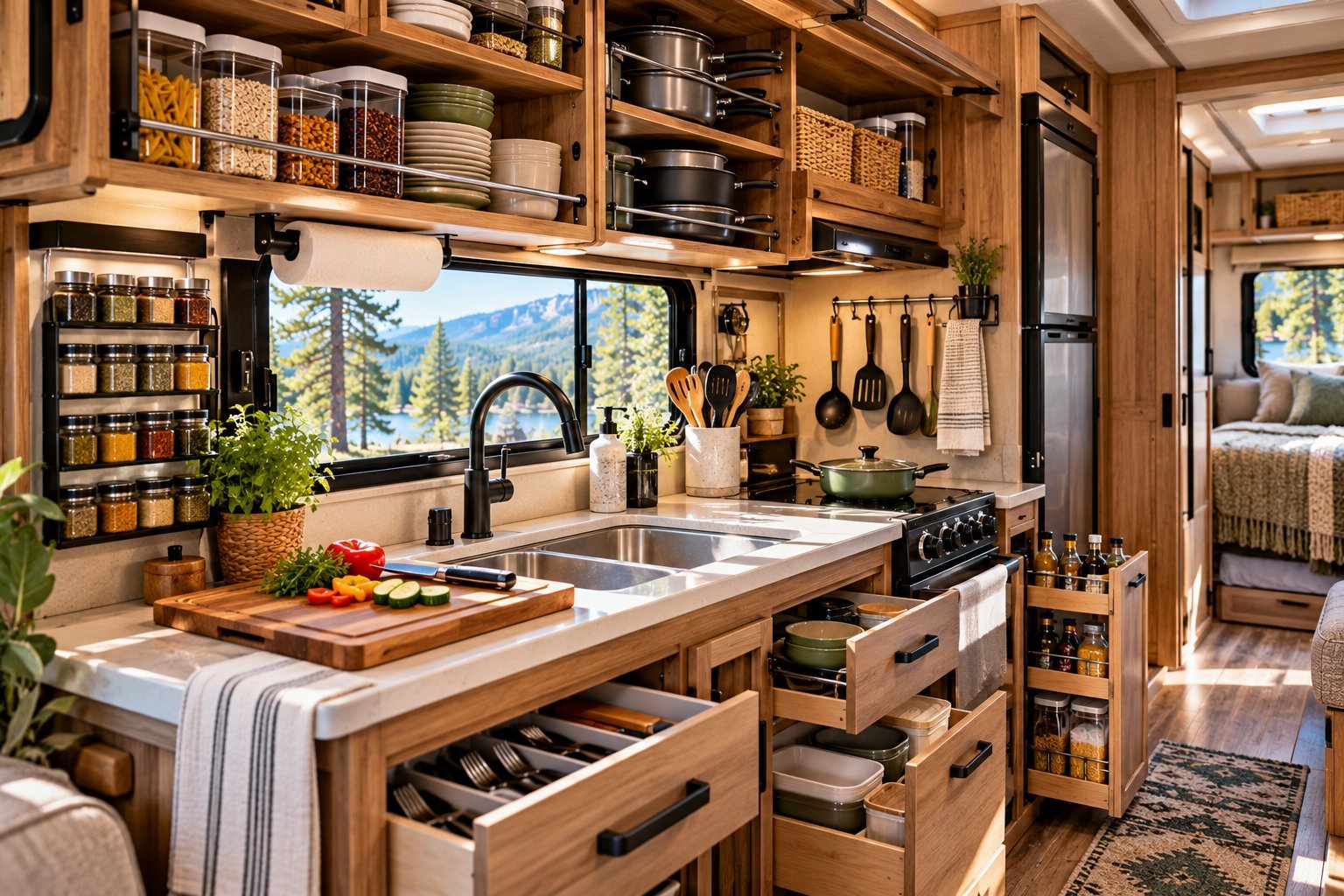
12 Genius Hacks to Double Your RV Kitchen Storage
A small RV kitchen can be surprisingly functional, but keeping everything organized becomes challenging when you have limited cabinets, narrow drawers, and barely enough counter space to prepare a meal.
Pots compete with plates for room, pantry items get pushed to the back of cupboards, and everyday cooking tools seem to multiply when you have nowhere to put them. The good news is that you do not need a bigger RV to create a more organized kitchen.
The secret is learning how to use the space you already have more effectively. Simple changes, such as organizing cabinet doors, stacking cookware, using vertical storage, and choosing compact kitchen essentials, can make a noticeable difference in how much you can store and how easily you can reach it.
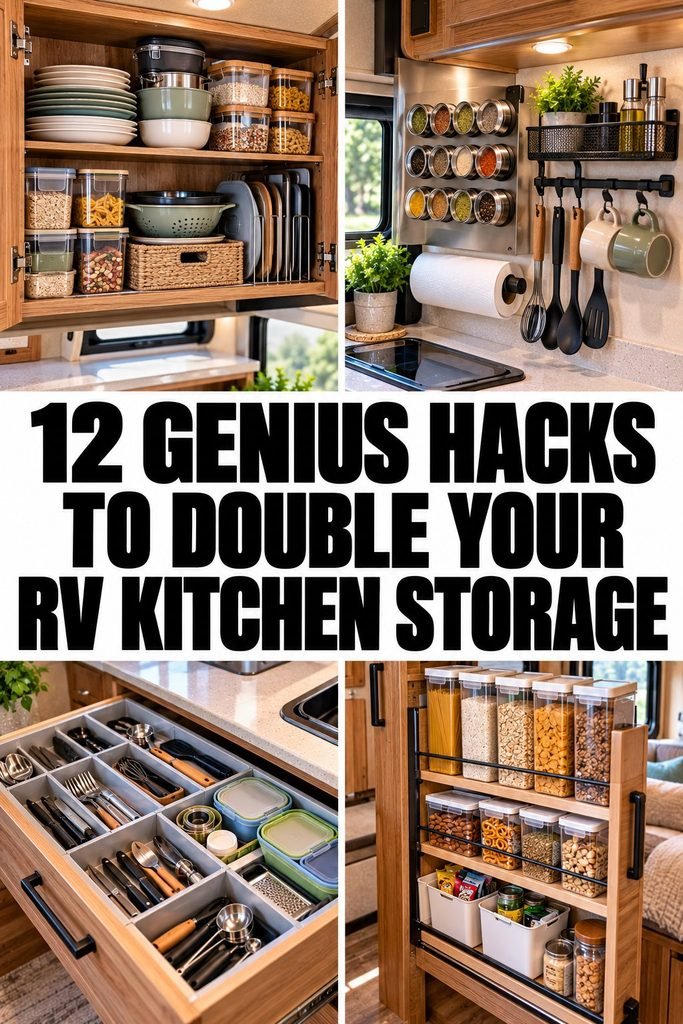
When planning a small RV kitchen, I would focus on practical solutions that make cooking easier without adding unnecessary clutter. Every organizer should have a purpose, fit the available space, and remain secure while traveling.
In this guide, we will explore 12 clever RV kitchen storage hacks that help you reclaim wasted space, keep your supplies organized, and make everyday meal preparation more comfortable.
1. Use the Inside of Cabinet Doors for Extra Storage
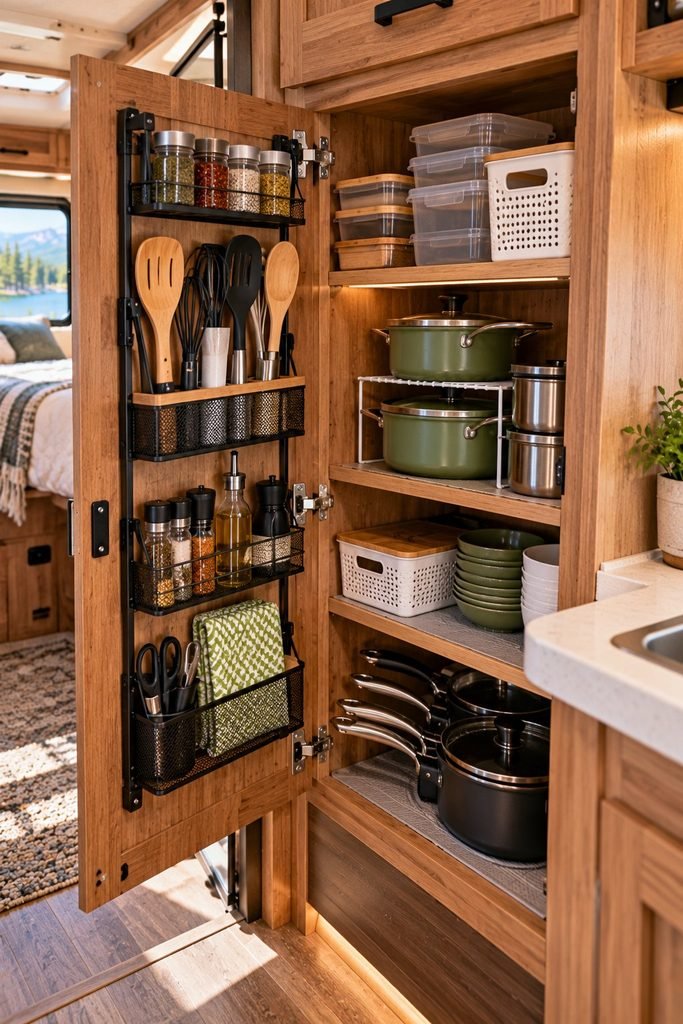
The inside of a cabinet door is one of the easiest places to overlook when organizing an RV kitchen. While the shelves hold your cookware, dishes, and pantry supplies, the door itself may offer additional space for lightweight items that otherwise occupy valuable drawers.
Making use of this hidden area can help you keep frequently used kitchen essentials within reach without adding another storage container to your countertop.
What can you store inside cabinet doors?
Measuring spoons and cups: A suitable holder can keep measuring tools together instead of letting them become mixed with other utensils.
Small kitchen utensils: Lightweight spatulas, peelers, and similar tools may fit inside a door mounted organizer designed for their size.
Seasoning packets: A slim pocket organizer can keep small packets together and prevent them from disappearing behind larger pantry items.
Kitchen towels: A suitable towel holder can provide a convenient place to keep a dish towel off the counter.
Pan lids: If the cabinet has enough clearance, a purpose designed lid organizer may help keep lids upright and accessible.
How to make this hack work
Start by opening the cabinet and checking how much room exists between the inside of the door and the stored items. A holder that looks compact on its own may prevent the cabinet from closing once it is installed.
Choose a mounting system that is compatible with the cabinet material. Removable adhesive holders may work on suitable surfaces, while other designs may require a different attachment method. Avoid drilling without checking for concealed wiring, plumbing, or other components.
Keep the stored items lightweight and secure. A cabinet door can move suddenly during travel, so loose utensils should not be left where they could fall or damage other belongings.
Space saving tip: Begin with one cabinet door and organize only the items you reach for regularly. This helps you see whether the extra storage is genuinely useful before adding more organizers.
2. Install a Stackable or Adjustable Shelf Inside Cabinets
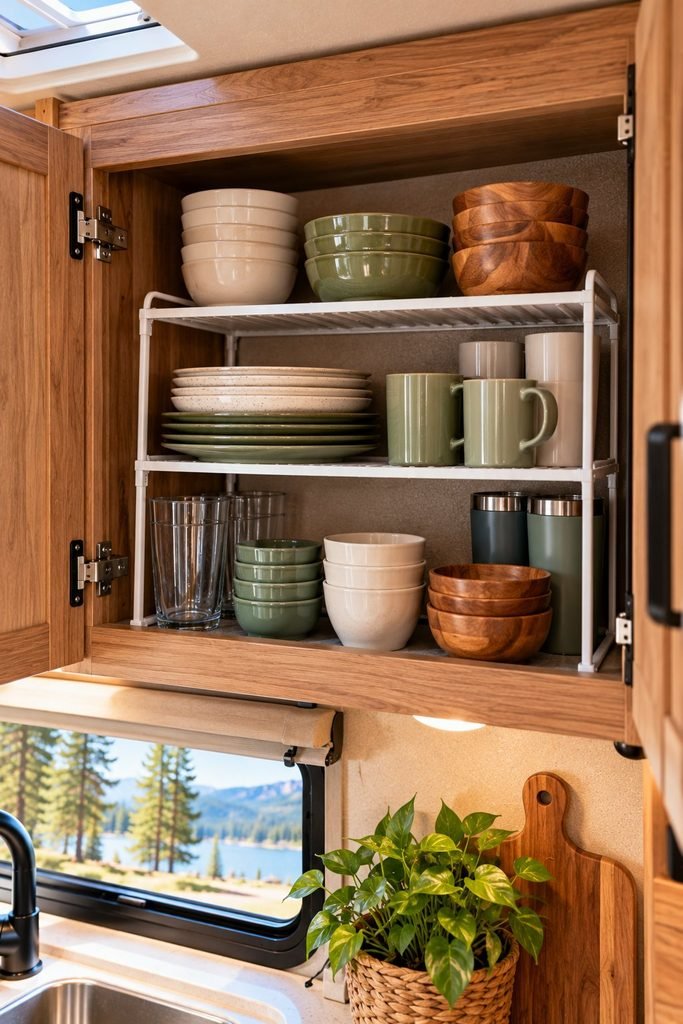
RV kitchen cabinets often have more vertical space than their existing shelves allow you to use efficiently. A tall cabinet might contain only one shelf, leaving a large gap above plates, mugs, or pantry containers.
An additional shelf or an adjustable cabinet organizer can divide that unused space into smaller sections. Instead of stacking everything in one tall pile, you can create separate areas for different kitchen essentials.
Where can extra shelves help most?
Plate cabinets: A compact shelf can create separate levels for plates and bowls, making it easier to reach the dishes you use every day.
Mug storage: A suitable shelf can separate mugs from other kitchen items and make better use of cabinet height.
Pantry cupboards: Small containers, seasoning jars, and lightweight packets can be grouped on separate levels.
Cleaning supply cabinets: If appropriate for the cabinet, an additional shelf can separate cloths and lightweight accessories from other supplies.
Choosing the right shelf organizer
Measure the cabinet’s width, depth, and available height before purchasing an organizer. Consider door hinges, cabinet frames, and the space needed to remove items without knocking over neighboring containers.
Look for a sturdy organizer with a load capacity suitable for the items you intend to store. Avoid placing heavy cookware on a shelf that is designed only for lightweight pantry goods.
Adjustable and removable designs can be especially useful because you can change the arrangement as your storage needs evolve. However, the organizer still needs to remain stable while the RV is moving.
Space saving tip: Group items by purpose rather than spreading them across multiple cabinets. Keeping breakfast supplies together, for example, can reduce the time you spend opening several cupboards every morning.
3. Switch to Nesting Pots, Pans, and Bowls
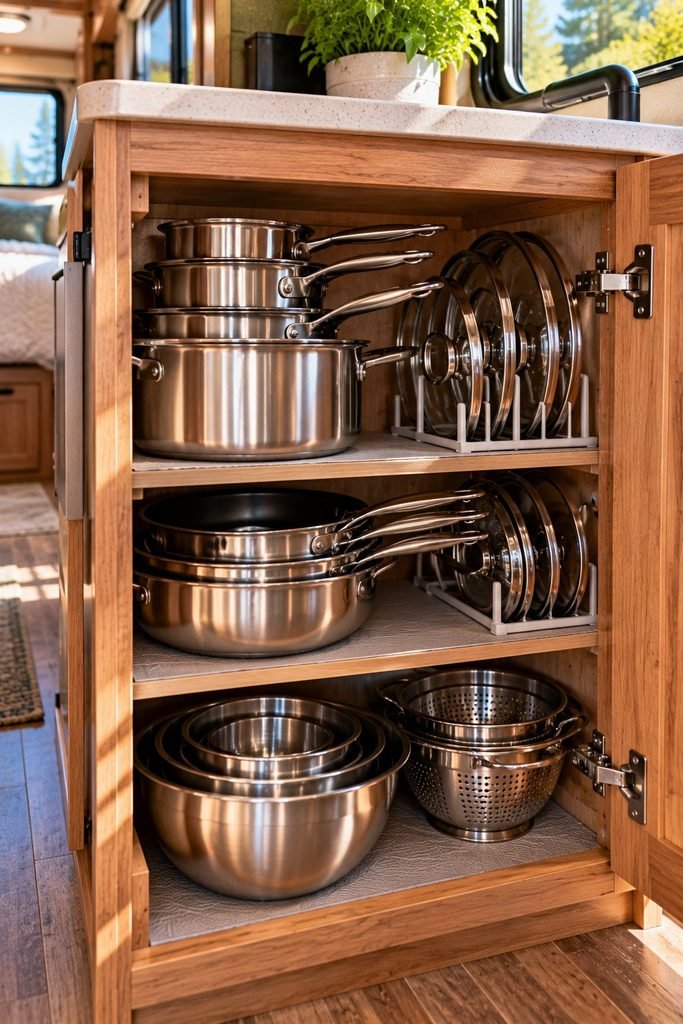
Cookware can consume a large portion of an RV kitchen cabinet because traditional pots and pans often have handles and shapes that prevent efficient stacking. Bowls and food containers can create similar problems when they do not fit inside one another.
Nesting cookware solves much of this difficulty by allowing smaller pieces to fit inside larger ones. This creates a more compact arrangement and leaves additional room for other essentials.
Which nesting kitchen items are worth considering?
Nesting pots and pans: Sets designed to stack together can reduce the amount of cabinet space required for cookware.
Nested mixing bowls: These are useful for preparing ingredients, serving meals, and storing leftovers without dedicating a separate shelf to every bowl.
Stackable food containers: Containers with compatible dimensions can be stored together when empty.
Nested measuring cups: These keep measuring tools together in a small drawer or utensil compartment.
Stackable dishes: Lightweight dishes designed to nest securely can be easier to store in narrow cabinets.
How to organize nesting cookware
Place the largest pot at the bottom and arrange smaller pieces inside it according to their design. Keep compatible lids together in a separate holder or in a designated section of the cabinet.
Before buying a cookware set, check its dimensions when fully stacked. Some sets save less room than expected because their handles and lids still require extra clearance.
It is also important to choose cookware compatible with your RV’s cooking appliances. If you use an induction cooktop, for example, confirm that the cookware is suitable for induction heating.
Space saving tip: Keep the pots and pans you use most often in the easiest cabinet to reach. Store occasional use pieces farther back, provided they remain secure and accessible.
4. Use Magnetic Storage for Suitable Metal Surfaces
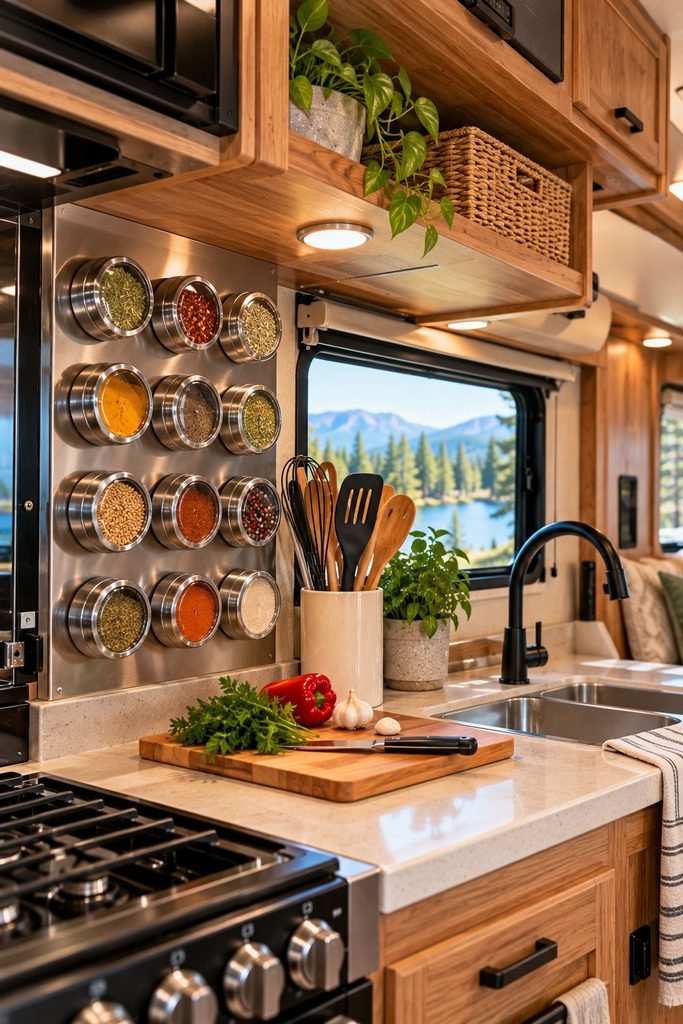
Magnetic storage can provide a convenient way to organize lightweight kitchen essentials without taking up shelf or drawer space. Depending on your RV’s layout, magnetic hooks or a suitable magnetic holder may help keep frequently used items accessible.
This approach works best when you have an appropriate metal surface and choose a product designed for the items you intend to store.
Useful magnetic storage ideas
Magnetic hooks: Use compatible hooks for lightweight kitchen towels or other suitable accessories.
Magnetic knife holder: A properly installed holder designed for kitchen knives can free up drawer space, provided it is positioned safely and the knives are securely retained.
Small utensil holders: Some magnetic organizers can hold lightweight utensils or accessories on suitable metal surfaces.
Magnetic spice containers: These may be useful for storing small quantities of seasoning if the containers have secure lids and the surface can support their weight.
Important considerations before installing magnetic storage
Not every RV cabinet or wall is magnetic. Some surfaces that appear metallic may have a plastic or wooden outer layer, so test the surface before purchasing accessories.
Check the manufacturer’s weight rating and make sure the magnetic attachment is suitable for the intended use. A holder that works while the RV is parked may not be secure enough when the vehicle is moving.
Sharp tools require particular care. Do not position knives where they could fall onto a counter, sink, or walkway. Remove or securely store loose kitchen tools before driving.
Space saving tip: Use magnetic storage selectively. A couple of well placed hooks or one suitable holder may be more useful than filling every available metal surface with accessories.
5. Add a Pull Out Organizer to Deep Cabinets
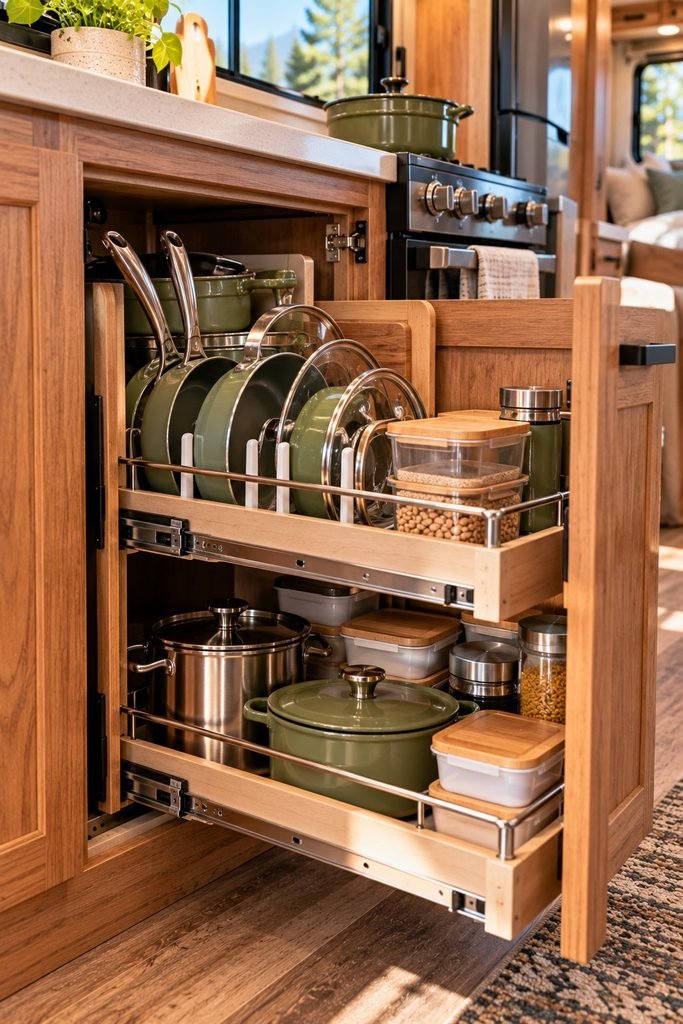
Deep RV kitchen cabinets can be difficult to use because items stored at the back are often hard to reach. You may find yourself removing several containers just to access a saucepan or pantry ingredient.
A pull out organizer can make the contents easier to reach by allowing a suitable shelf or basket to slide forward. This can help you use the full depth of the cabinet rather than treating the back section as forgotten storage.
Where can pull out organizers help?
Under sink cabinets: A suitable pull out basket can make cleaning accessories easier to access, provided it accommodates plumbing and other equipment.
Deep pantry cupboards: Sliding baskets can help group dry goods and packaged snacks.
Cookware cabinets: A suitable sliding shelf may make pots and pans easier to retrieve.
Small utility cabinets: Pull out compartments can help organize lightweight kitchen accessories.
How to choose the right organizer
Measure the cabinet’s interior width, depth, and height. Remember that hinges, plumbing pipes, and cabinet frames can reduce the usable dimensions.
Check the installation requirements, weight rating, and clearance needed for the organizer to slide out fully. If installation requires drilling, inspect the area carefully before making changes.
For an RV, the organizer should also remain secure during travel. Look for a design with suitable retention features, or use an appropriate way to secure the contents and prevent the shelf from sliding open while driving.
Space saving tip: Place the items you use most often in the front of the organizer and reserve the back for occasional use supplies. That way, you get easier access without having to rearrange the entire cabinet.
6. Use Slim Containers to Organize Your RV Pantry
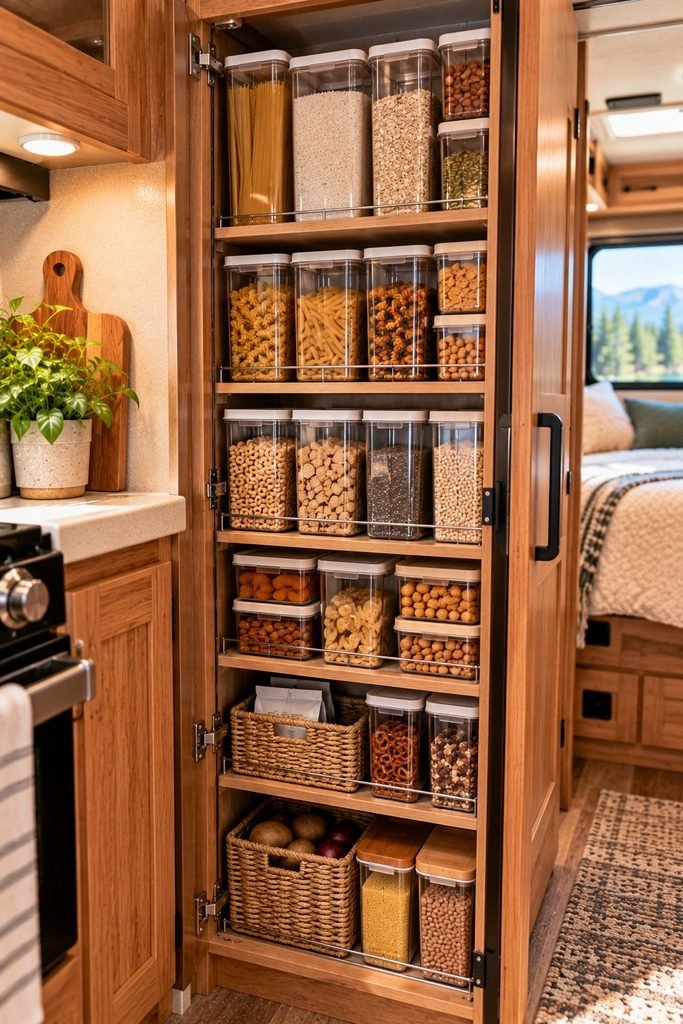
Food packaging comes in many different shapes and sizes, which can make a small pantry difficult to organize. Bags of snacks, boxes of cereal, packets of seasoning, and jars of ingredients often leave awkward gaps between items.
Slim storage containers can help create a more consistent arrangement, particularly when they fit the depth and width of your existing shelves.
What should you store in slim containers?
Dry snacks: Group suitable packaged snacks in a designated container.
Baking ingredients: Store frequently used dry ingredients in appropriately sized, food safe containers.
Seasoning packets: Use a small organizer to prevent packets from spreading throughout the cabinet.
Tea and coffee supplies: Keep these together in a compact container or basket.
Small pantry staples: Arrange suitable dry goods in containers that fit the available shelf dimensions.
How to organize your pantry efficiently
Measure the shelves before buying a collection of containers. Choose shapes that allow you to use the available space without blocking cabinet doors or making items difficult to remove.
Transparent containers can make it easier to see what you have, while labels can help identify ingredients quickly. Make sure containers are clean, dry, and suitable for food storage.
Keep heavy containers on lower shelves when possible, and secure them so they cannot slide around while traveling. Avoid filling containers to the point where their lids become difficult to close.
Space saving tip: You do not need to transfer every grocery item into a new container. Focus on the foods that create the most clutter, and keep other ingredients in their original packaging when that arrangement works better.
What to Prioritize Before Buying More RV Kitchen Storage
Before moving on to the remaining hacks, take a few minutes to identify the main problem in your kitchen. If your cabinets are too tall, an additional shelf may help. If the pantry is difficult to reach, a pull out organizer might be more useful. If your cookware takes up most of the available space, nesting pots and bowls may be the better investment.
The aim is to solve specific storage problems rather than add products simply because they are marketed for RV living.
Measure your cabinets, consider the weight of your belongings, and make sure every organizer is appropriate for a moving vehicle. Storage should make everyday cooking easier while keeping walkways clear and essential equipment accessible.
7. Use a Space Saving Spice Rack That Fits Your Layout
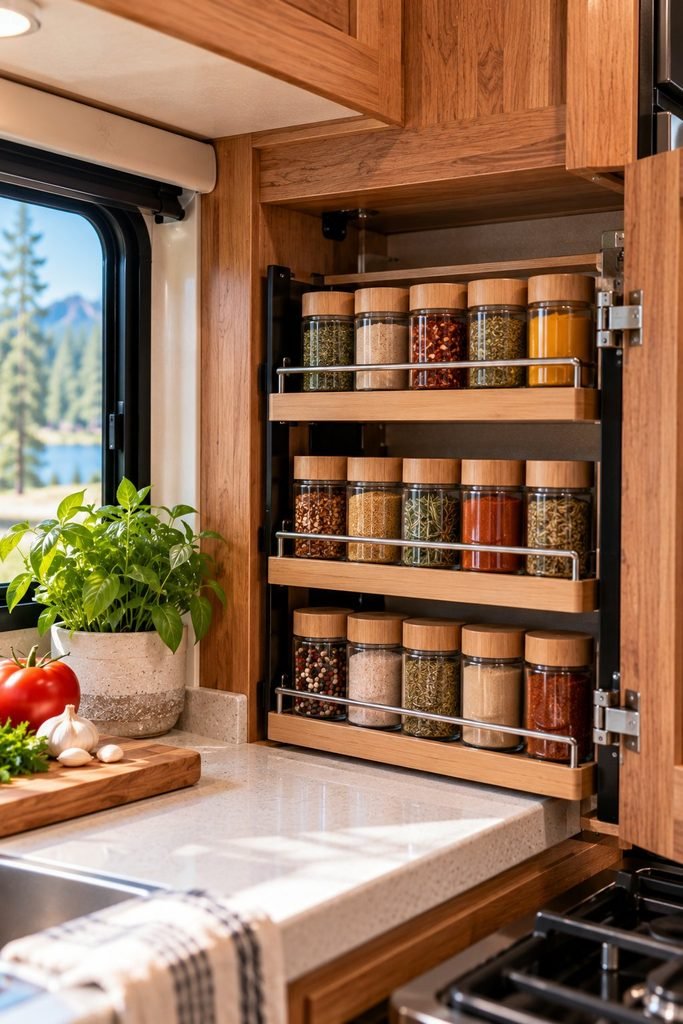
Spices can take up more room than expected in a small RV kitchen, especially when you keep them in their original packaging. Round jars often roll around, bulky containers waste shelf space, and finding the seasoning you need can become frustrating when everything is crowded together.
A dedicated spice rack helps keep your seasonings organized without sacrificing valuable cabinet space.
Here are a few practical ways to store spices in an RV kitchen:
- Use a narrow tiered spice rack: A tiered organizer allows you to see several rows of spices at once instead of hiding smaller jars behind taller containers.
- Try magnetic spice containers: If you have a suitable metal surface, magnetic containers can free up shelves. Make sure the magnets hold securely during travel.
- Store spices in uniform containers: Matching square or rectangular containers can fit together more efficiently than jars of different shapes.
- Label every container clearly: Put labels on the front or lid so you can identify seasonings quickly, even when the containers are packed tightly together.
- Keep everyday seasonings within reach: Store frequently used spices near your cooking area and move occasional seasonings to a less accessible cabinet.
Before purchasing a spice rack, measure the available space and check how much clearance you need to open cabinet doors or drawers. A rack that looks compact online might be too tall or wide for your RV.
Also, remember that anything stored near the cooking area should remain safely away from direct heat.
The goal is to make your seasonings easy to find while using as little space as possible.
8. Make Use of Vertical Wall Space
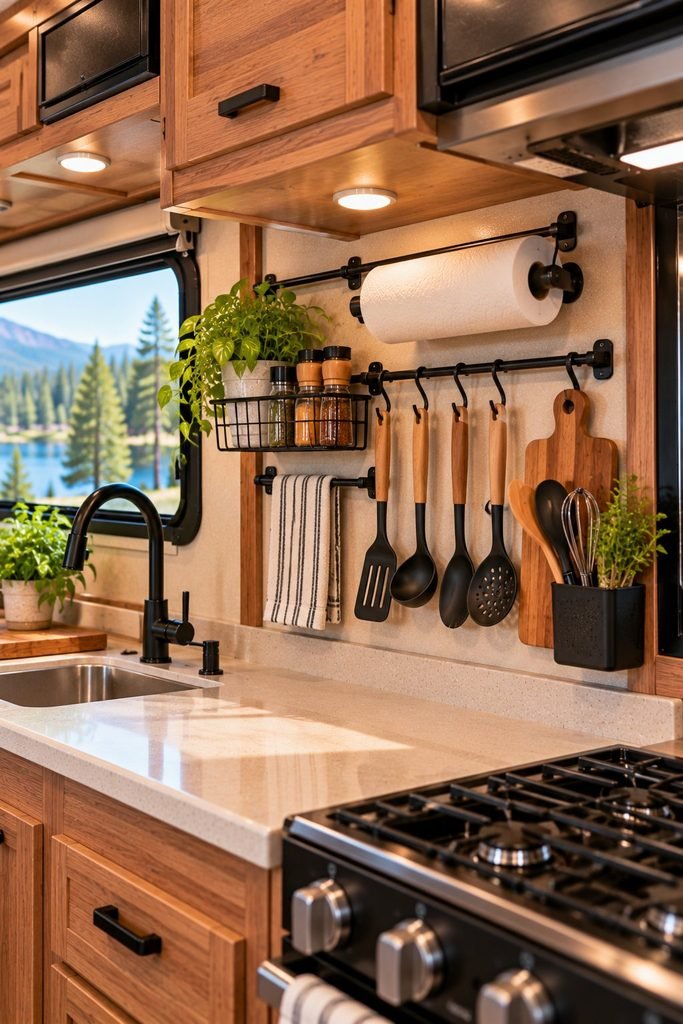
When cabinet space is limited, look at the unused vertical areas in your RV kitchen. The side of a cabinet, an appropriate backsplash area, or a clear section of wall may offer storage opportunities that do not take up your countertop.
The key is to choose lightweight items and secure them properly for travel.
Consider these vertical storage ideas:
- Install a small rail with hooks: Use it for lightweight utensils, measuring spoons, or other frequently used tools.
- Hang oven mitts and pot holders: A dedicated hook can free up a drawer or cabinet.
- Use a compact wall mounted basket: This can hold lightweight items such as napkins, wrapped snacks, or small kitchen accessories.
- Add a holder for paper towels: A suitable wall or cabinet mounted holder can keep the roll off the counter.
- Use the side of a cabinet: A properly secured organizer can create storage without occupying the main preparation area.
Not every RV wall can safely support screws or adhesive accessories. Before drilling, check for hidden wiring, plumbing, and structural limitations. If you choose adhesive mounting hardware, follow the manufacturer’s instructions and consider the effects of heat, moisture, and movement.
Avoid hanging heavy cookware overhead or placing breakable items where they could fall during travel.
I would also recommend keeping vertical storage simple. A few carefully chosen organizers can make the kitchen more functional, while too many hooks and baskets can make a small space feel crowded.
9. Organize Drawers With Adjustable Dividers
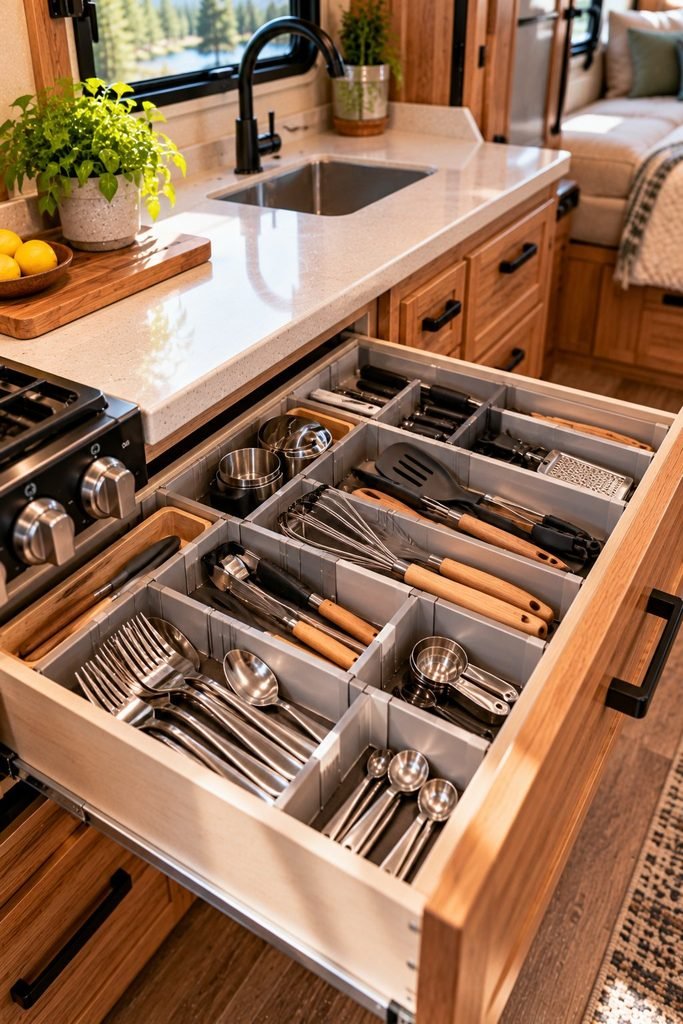
Kitchen drawers can become surprisingly inefficient when utensils, cooking tools, and miscellaneous accessories are thrown together. You may have enough room for everything, but without a clear system, the contents shift around and usable space disappears.
Adjustable drawer dividers help you organize the space according to what you actually own.
Instead of buying a large organizer designed for a standard home kitchen, look for slim dividers or modular trays that fit your RV drawers.
Here is how to get better results:
- Empty the drawer and remove items you rarely use.
- Measure the drawer’s interior width, depth, and height.
- Group similar items together, such as cutlery, measuring tools, and cooking utensils.
- Choose dividers that fit the drawer without wasting space around the edges.
- Place heavier utensils low and keep frequently used tools easy to reach.
- Check that the drawer closes completely and that the dividers remain in place when the RV moves.
Expandable dividers are especially useful because you can adjust them as your storage needs change. Small compartment trays can also help organize items such as measuring spoons, clips, and reusable food bag seals.
For deep drawers, consider whether a second shallow organizer could sit above the lower layer without preventing the drawer from closing. However, avoid stacking items so high that they become difficult to remove or shift during travel.
One important tip: Do not automatically dedicate an entire drawer to utensils. If your RV has only a few drawers, assign each one a clear purpose and reserve the most accessible drawer for the tools you use every day.
An organized drawer makes cooking easier because you spend less time searching for basic equipment.
10. Use an Over the Sink Cutting Board for Extra Workspace
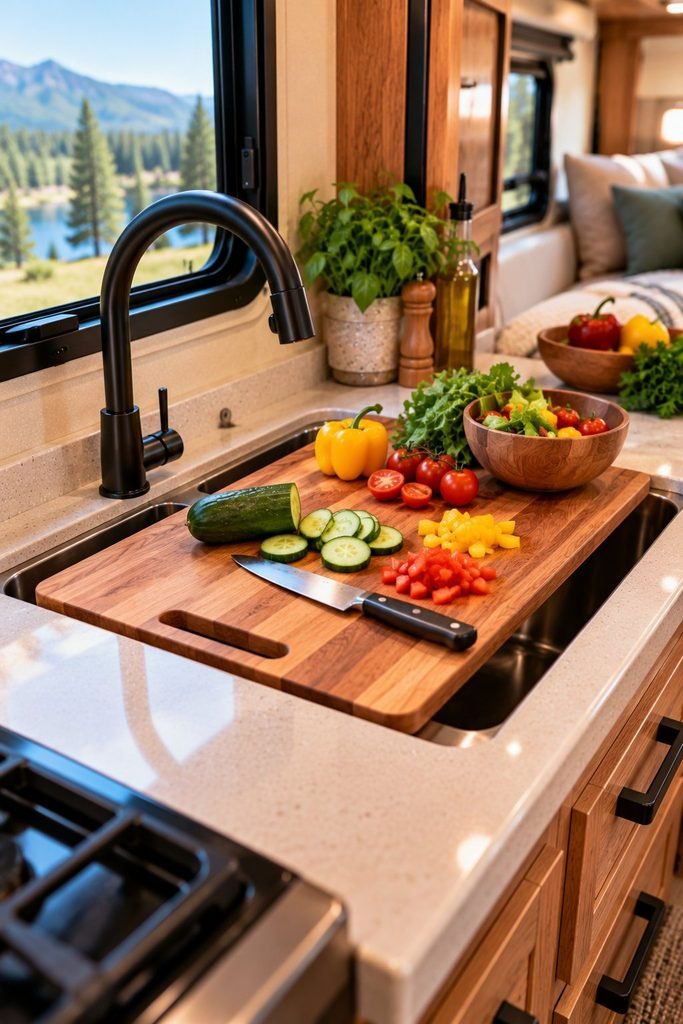
Countertop space is often one of the biggest challenges in an RV kitchen. A compact sink can take up a large portion of the available work area, leaving very little room to chop vegetables, prepare sandwiches, or arrange ingredients.
An over the sink cutting board can help solve this problem by creating a temporary preparation surface above the sink.
Some designs have extending handles that rest across the sink, while others include integrated colanders or removable sections. Choose a model that matches your sink dimensions and leaves enough room for safe food preparation.
Here is why this option can be useful:
- Creates additional preparation space: You can use the area above the sink while preparing ingredients.
- Keeps food preparation organized: A well fitted board can help contain chopped vegetables and other ingredients.
- May combine several functions: Some models include draining baskets or collapsible components.
- Can be removed when needed: You can lift the board away to access the sink for washing dishes.
Before buying one, measure the sink opening and check the manufacturer’s stated dimensions. The board should sit securely without rocking, slipping, or placing excessive weight on the sink edges.
It should also be easy to store when you are driving. Never leave it balanced across the sink during travel unless it is specifically secured for that purpose.
When preparing raw meat, use an appropriate food safe surface and clean it thoroughly between tasks. If the board has several components, make sure every section can be washed and dried properly.
For an especially small RV kitchen, this can be one of the most useful additions because it makes better use of an area you already have instead of requiring a permanent countertop extension.
11. Choose Collapsible and Multi Purpose Kitchen Tools
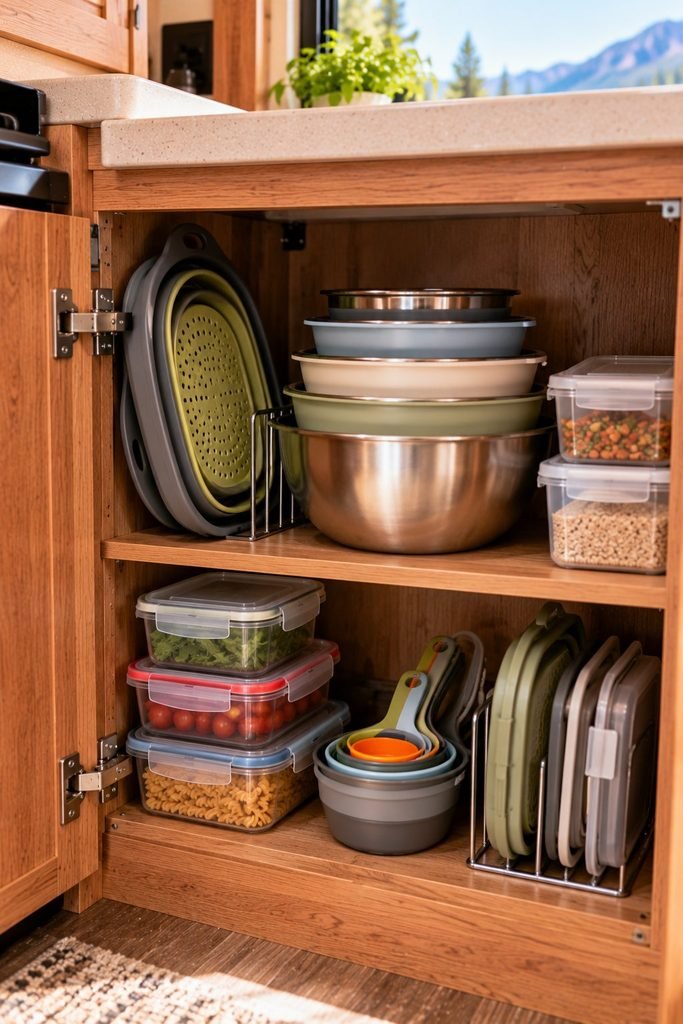
Bulky kitchen equipment can quickly fill an RV cabinet. A full set of mixing bowls, separate measuring containers, large colanders, and single purpose gadgets may be convenient in a house, but they can consume valuable storage space in a camper.
One solution is to replace selected bulky items with collapsible or multi purpose alternatives.
Collapsible kitchen tools flatten or fold when you are finished using them. Multi purpose tools perform several jobs, helping you reduce the total number of items you need to store.
Consider these space saving options:
- Collapsible colanders: These can flatten for storage after washing vegetables or draining pasta.
- Nesting mixing bowls: Different bowl sizes fit inside one another instead of occupying separate shelves.
- Stackable food storage containers: Containers with compatible shapes and sizes are easier to organize.
- Compact measuring tools: A nesting measuring cup and spoon set can replace several loose pieces.
- Multi purpose cooking utensils: A carefully chosen utensil may perform several tasks without requiring a separate tool for each one.
- Foldable dish drying racks: These can be packed away when you need the counter for meal preparation.
However, avoid buying every collapsible product you see. Some designs are less sturdy than their traditional counterparts, and flexible materials may not be suitable for every cooking task.
Prioritize items you use regularly. If you rarely bake, for example, there may be little reason to replace your existing baking equipment with a collapsible set.
It is also worth checking whether a product is dishwasher safe, heat resistant, and easy to clean before purchasing it.
The best approach is to reduce duplication rather than eliminate useful equipment. Keep the tools that help you cook comfortably and remove those that take up space without serving a regular purpose.
12. Secure Your Storage With Non Slip Liners and Travel Friendly Organizers
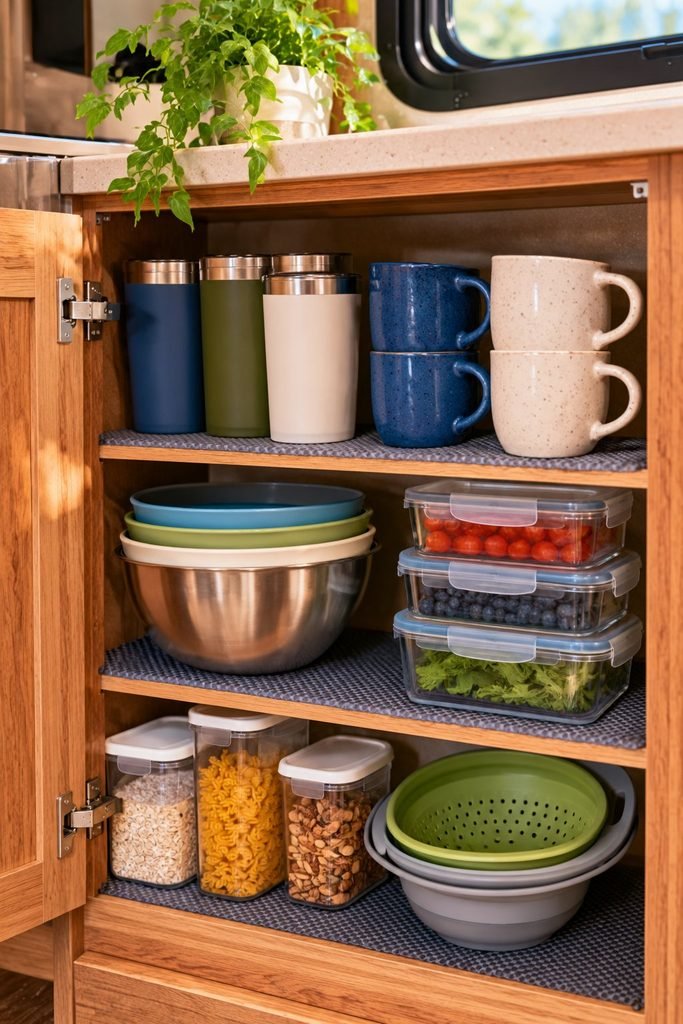
Adding organizers is only half the job. In an RV, kitchen items must also stay in place when the vehicle is moving.
A beautifully arranged cabinet can become a mess after one journey if containers slide, lids come loose, or stacked dishes shift around. That is why securing your storage should be part of your overall organization plan.
Non slip shelf liners can help prevent lightweight containers from moving around on smooth surfaces. Small bins can keep similar items grouped together, while properly fitted drawer organizers can reduce movement inside drawers.
Here are some ways to make your storage more travel friendly:
- Use non slip liners: Cut liners to fit cabinet shelves and drawers, following the product instructions.
- Group small items in bins: Place snack packets, seasoning containers, and other loose items in appropriately sized organizers.
- Keep heavier objects low: Store heavy cookware in lower cabinets when practical, and avoid placing heavy objects overhead.
- Prevent dishes from rattling: Use suitable separators or protective padding between fragile items.
- Check cabinet closures: Make sure doors and drawers latch securely before setting off.
- Leave room for movement: Do not overfill cabinets to the point where items become trapped against the doors or prevent them from closing.
Be careful when choosing shelf liners. They should be suitable for the surface, easy to clean, and appropriate for the temperatures and conditions inside your RV.
Also, do not assume that a non slip mat alone will keep everything secure during sudden braking or sharp turns. Use appropriate restraints, closed storage, and secure latches whenever necessary.
Before every trip, take a quick look through your kitchen. Close cabinet doors, secure loose equipment, and make sure nothing can fall onto the floor or into a cooking area.
A good RV kitchen storage system should work just as well on the road as it does when you are parked.
How to Put These RV Kitchen Storage Hacks Into Practice
You do not have to install every organizer or replace all your kitchen equipment to make a noticeable difference. The most effective approach is to work with the space you already have, identify what causes the most frustration, and make small improvements that solve real problems.
If your RV kitchen feels cramped, I recommend starting with one cabinet or drawer at a time. This makes it easier to see what is working and prevents you from spending money on storage products you do not actually need.
Step 1: Empty One Storage Area at a Time
Choose a cabinet, drawer, or pantry shelf and remove everything inside. Group the contents into categories, such as cookware, utensils, dry ingredients, snacks, and cleaning supplies.
This helps you identify duplicate items, forgotten ingredients, and equipment that takes up space without serving a useful purpose.
You do not need to get rid of everything you rarely use, but you should consider whether each item deserves a place in your limited kitchen storage.
Step 2: Measure Before Buying Organizers
Measure the interior dimensions of your cabinets, drawers, and pantry shelves. Pay attention to hinges, pipes, curved walls, and other features that might reduce the usable space.
When shopping for organizers, compare their actual dimensions with your measurements rather than relying on product photographs.
For RV kitchens, a narrow organizer that fits perfectly is often more useful than a larger product that leaves awkward gaps or prevents a cabinet door from closing.
Step 3: Give Every Item a Dedicated Place
A simple storage system works best when every kitchen item has a specific home.
For example, you might keep cooking utensils near the stove, frequently used spices in one compact rack, and food preparation tools in a dedicated drawer.
Store heavier cookware in lower cabinets when possible, and keep everyday essentials accessible without placing them where they could fall during travel.
Once everything has a designated place, tidying up after cooking becomes much easier.
Step 4: Use Vertical Space Without Overcrowding It
Look for opportunities to store lightweight items on suitable wall sections, inside cabinet doors, or on unused cabinet sides.
However, do not fill every available surface with hooks, baskets, and racks. Too many accessories can make a compact kitchen harder to use.
Choose storage solutions that free up counter space and improve access to your essentials. If an organizer makes it difficult to open a door or reach another item, it may not be worth keeping.
Step 5: Test Your Setup Before Your Next Trip
After organizing your kitchen, close every drawer and cabinet and check that the contents remain secure.
Move items around gently to identify anything that slides, rattles, or tips over. Use suitable liners, dividers, containers, and latches where needed.
Before driving, make sure all loose items are stored safely and that nothing can fall into the cooking area.
A storage system is only successful if it remains practical when you are preparing meals, cleaning up, and traveling.
Common RV Kitchen Storage Mistakes to Avoid
Even well intentioned organization projects can make a small kitchen less functional if the solutions are not suited to the available space.
Here are a few mistakes worth avoiding.
Buying Organizers Before Measuring
A storage product may look ideal online but turn out to be too tall for a cabinet or too wide for a drawer.
Always measure first, including the space needed for hinges, handles, and doors to open properly.
Keeping Too Many Kitchen Gadgets
Single purpose gadgets can consume valuable space, particularly when you have several tools that perform similar functions.
Consider which items you use most often and whether a practical multi purpose alternative could replace a few rarely used tools.
The goal is not to create an unusually minimal kitchen. It is to keep the equipment that makes cooking easier without allowing unnecessary items to take over.
Overloading Cabinet Doors
Cabinet door organizers can be excellent space savers, but their weight and depth matter.
Heavy items may strain hinges, while deep containers can interfere with shelves or prevent doors from closing.
Choose lightweight organizers and confirm that the cabinet can support the added load.
Ignoring Weight Distribution
Storage decisions in an RV should account for more than convenience.
Avoid placing heavy cookware in overhead cabinets, and follow your vehicle manufacturer’s guidance for loading and weight distribution. Secure all stored items before driving.
Choosing Looks Over Function
Matching containers and attractive organizers can make a kitchen look tidy, but they are not automatically the best use of space.
A practical container that fits your cabinet and keeps food secure is more valuable than a decorative one that wastes room.
Focus on accessibility, durability, cleaning, and safe storage before appearance.
Filling Every Empty Space
It can be tempting to treat every small gap as an opportunity to add another organizer. However, a kitchen that is packed too tightly becomes difficult to clean and use.
Leave enough room to remove containers, reach frequently used items, and access important equipment without rearranging the entire cabinet.
A Simple RV Kitchen Storage Checklist
Use this checklist to keep your organization project manageable.
- Remove duplicate and unnecessary kitchen items.
- Measure cabinet interiors, drawers, and pantry shelves.
- Install suitable organizers inside cabinet doors.
- Use stackable shelves to make better use of cabinet height.
- Replace selected bulky items with nesting or collapsible alternatives.
- Arrange spices and pantry ingredients in accessible containers.
- Add drawer dividers for utensils and cooking tools.
- Consider an over the sink cutting board for additional preparation space.
- Use suitable non slip liners and travel friendly storage bins.
- Check cabinet doors, drawer latches, and loose items before every trip.
- Reassess the setup after a few meals and adjust anything that feels inconvenient.
You can complete these tasks gradually. Start with the areas that cause the biggest problems, then make additional changes as needed.
Final Thoughts on Doubling Your RV Kitchen Storage
Making an RV kitchen feel larger does not always require a renovation or expensive storage system. Sometimes, the biggest improvements come from using cabinet doors, taking advantage of vertical space, choosing nesting cookware, organizing drawers, and keeping loose items securely stored.
I would start by identifying the three areas that frustrate you most. Perhaps your pantry is overcrowded, your cookware takes up an entire cabinet, or your countertops disappear whenever you prepare a meal. Solve those problems first, then decide which additional changes would make everyday cooking easier.
Remember that the best RV kitchen is not necessarily the one with the most organizers. It is the one where you can find what you need, prepare meals comfortably, clean up without hassle, and secure everything before heading down the road.
With a few thoughtful adjustments, even a compact camper kitchen can become more organized, efficient, and enjoyable to use.
You may not physically double its storage capacity, but you can make much better use of the space you already have.